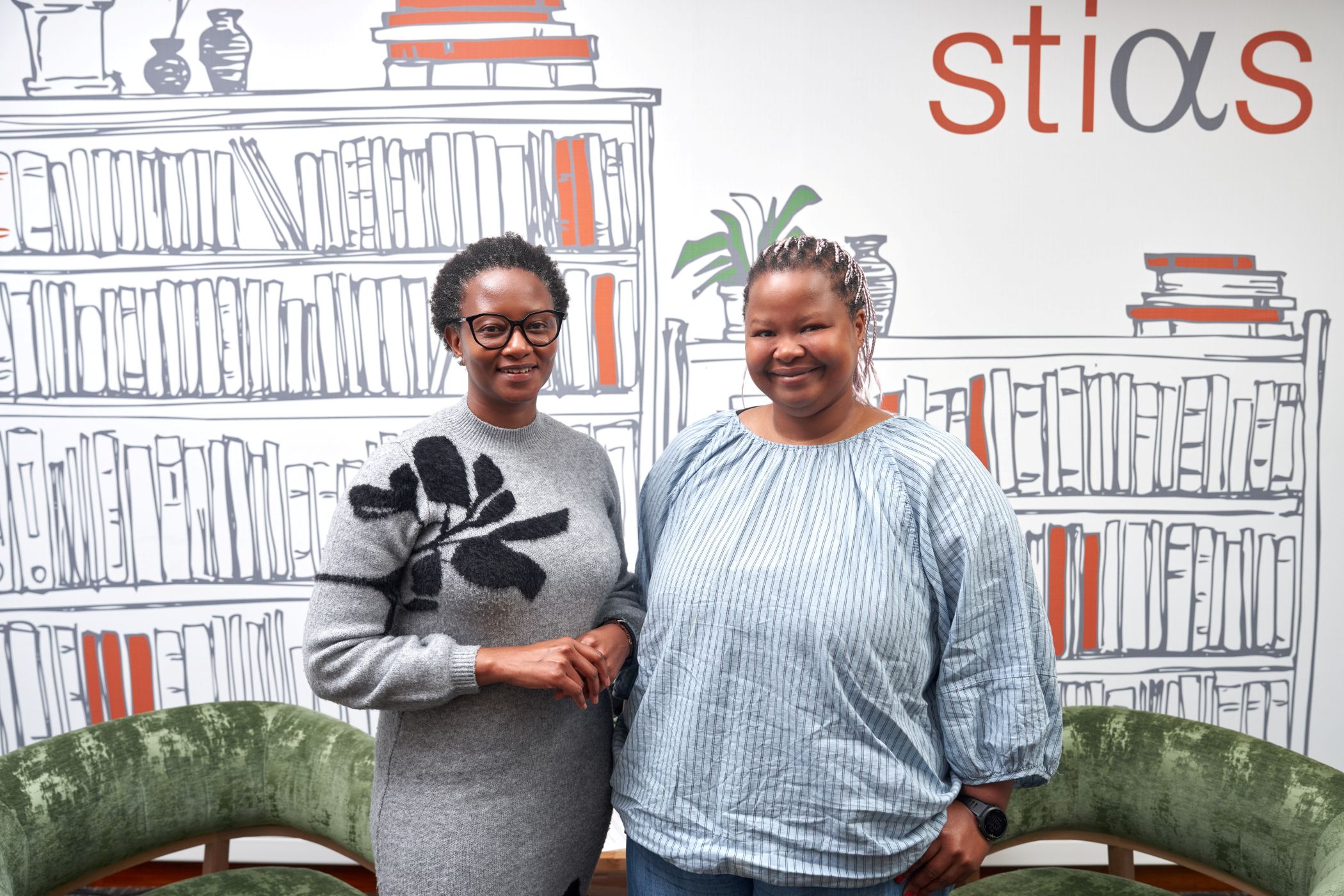
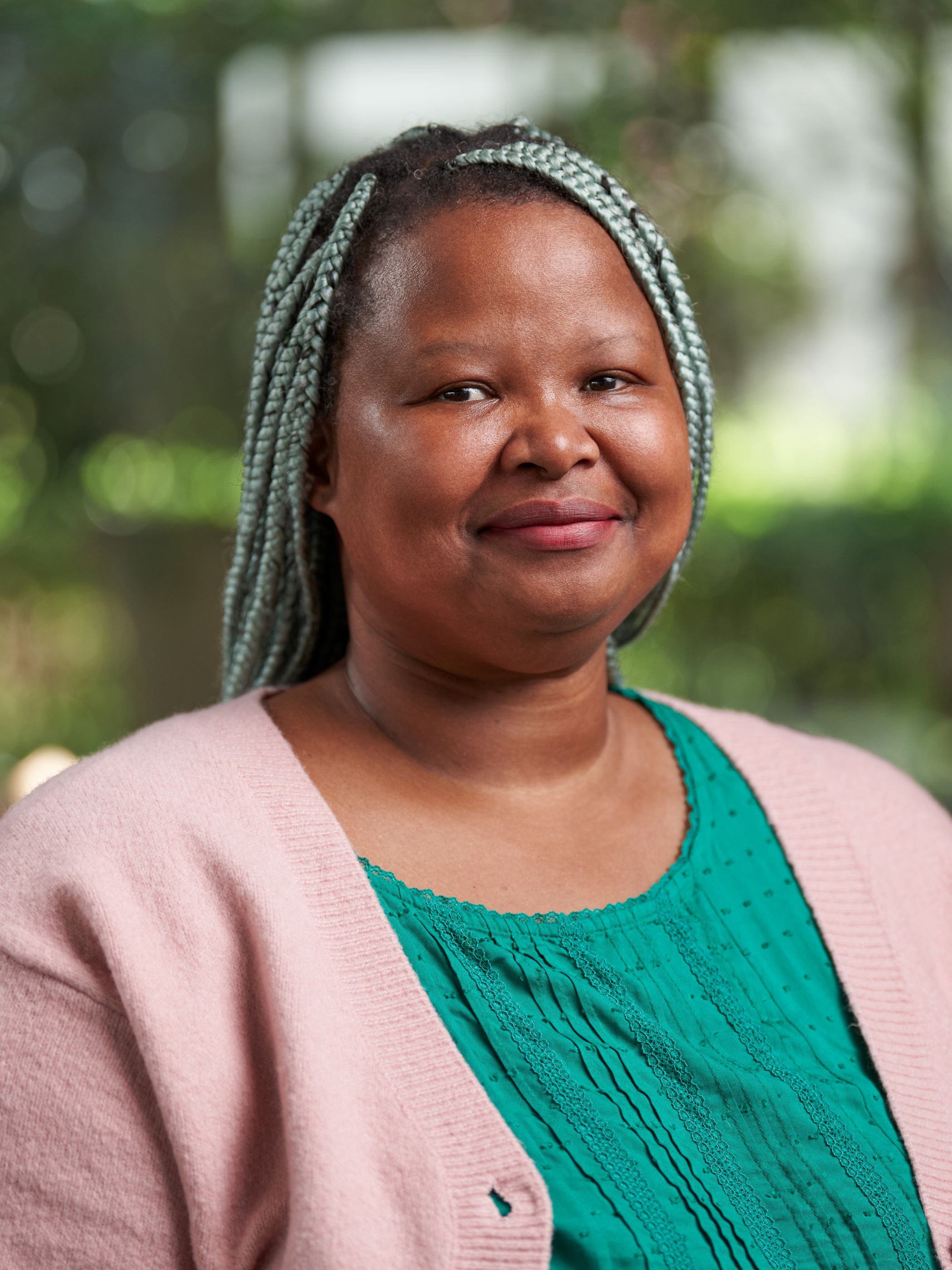
Iso Lomso fellow Thando Njovane is based in the Department of Literary Studies in English at Rhodes University. Her project reframes the study of postcolonial African trauma literature by restoring attention to literature’s artistic form, not only its historical and political function. Njovane introduces ‘Artliness’ as a concept between aesthetics and poetics, using it to examine how language, embodiment, silence and representation shape experiences of trauma and intimacy.
Njovane challenges established trauma theory for imposing culturally imperialist frameworks, privileging Western scholarship and reducing African texts to records of collective suffering or political resistance. She argues that language is inherently unstable and never fully captures experience; however, its failure in the face of trauma need not signify only absence, silence, lacuna, or defeat. Instead, literature can create a space in which people reach toward one another despite incomplete signs and imperfect understanding.
By reading African literature as art, Njovane hopes to shift attention away from the African as politico-historical subject and more towards somatic, psychic, linguistic and spiritual subjectivity, and toward the individual as well as the collective. In so doing, she believes we might be able to reach a more humane and potentially redemptive account of trauma: not intimacy as a solution, but literary expression as a means of imagining connection, shared humanity and alternative ways of being with others.
For her seminar, she offered a deliberation on trauma theory, intimacy, and postcolonial African literature as an aesthetic with the aim of recovering the artliness of the form, and by placing existential, psychic, and linguistic subjectivity at the core of recognition and representation. “My seminar is on artliness and being, language and representation and traumatic intimacies.”
And for those already wondering, she explained: “Artliness is not a word. I needed a term that would not just be about poetics or just aesthetics, a term that would also be about how we speak about these two things, so I made it up. This is a concept that, together with intimacy, will run through the book.”
Language and representation
Starting with a definition of language, Njovane noted that language is merely a symbolic system we have all agreed to. “Language is arbitrary; we agree on meaning. The word doesn’t capture the essence of what the thing it represents is out in the world. This is also why language is, as Slovenian philosopher Slavoj Žižek wrote, “the first and greatest divider.”
She also reminds us that the late Ngũgĩ Wa Thiong’o points out that language is at the centre of the colonial project. It was meant to outlive empire, “to do to the mind what it has done to the body,” she said. Postcolonial African writing thus “points to a schizophrenic project in a medium already alienating. But deconstruction frames language as already broken, and because of this it is disarmed, stripped of its authority, and becomes an insufficient tool of subjection. “To write, to speak, to narrate is to inhabit linguistic subjectivity in an impossible space. Communication lies in the message not landing as intended.”
“However, if lack of words is only an impenetrable black hole, you are insisting on defeat,” she continued. “I’m aiming to offer a way of talking or writing about what this collapse might mean”
Traumatic intimacies
Njovane also explained that as an analytic lens typically used to interrogate the lives and afterlives of subjection, trauma theory has a bad reputation when it comes to its dealings with postcolonial contexts, particularly where this applies to questions of difference. “Within the ‘decolonising trauma’ debate, African letters are positioned as socio-historical and political cultural objects still bound to the 1960s plight where ‘The Empire Writes Back’ in what appears to be a culturally relativist way.”
She further noted that from the 19th century the European viewpoint and an anthropomorphic gaze were standardised in postcolonial writing and in its historical, political, social and militant formulation of scholarship around this writing
In the 1990s, trauma theory studies were introduced at Yale and by the 2000s this lexicon was being applied to African texts. “But applying trauma theory to postcolonial literature cannot be done without cultural imperialism – this is an ongoing debate,” she said.
’Trauma theory was supposed to be ‘a link between cultures’ but hasn’t lived up to the ideal,” she continued. “A large part of the reason for this is the insufficient engagement with scholarship from the Global South.” Here she pointed to the substantial body of scholarship from the Global South that is not generally acknowledged in trauma theory and is not in the trauma lexicon. She specifically acknowledged the work of Pumla Gobodo-Madikizela on how trauma is passed down through generations and on the inadequacy of the accepted theories, and Hugo ka Canham’s work on theorising black experience.
“The story of trauma is a story of survival,” said Njovane. “African literature has always been a literature bearing witness, and reimagining historical realities long before the arrival of trauma theory.”
“It is insufficient to say that we suffer differently because we are different. I want to build a lexicon grounded in our shared humanity,” she continued.
African literature as art
So how do we bring this all together? Njovane believes part of the answer to decolonising trauma theory lies in paying more attention to African literature as art.
“If we take Kenyan novelist Yvonne Adhiambo Owuor’s novel Dust as just one example. Critics and scholars have read the socio-political and historical as its essential value. It’s been read as a cultural record of a specific moment. The artistry of the novel is swallowed by this kind of reading.”
“This is dealing with Africans as historical subjects with little attention to Africans as psychological subjects and to African literature as works of art, and this is where my intervention is located.”
“I posit that artliness subverts the inherent pessimism that accompanies established trauma theory – that is, culturally relativist ideas about healing, intergenerational transmission, and the persistent binary between mourning and melancholia,” she explained. “I do this by framing the site of language as one of mediation, legibility and translation, arguing that this rhetorical move transforms our understanding of trauma into something a lot more redemptive, more human, a little more humane: intimacy.
Ultimately, I insist that the failure of the written word in the face of the traumatic is not necessarily only aporia or emptiness, but rather a site of possibility, a generative space of intimacy,” she concluded.
Article: Michelle Galloway
Picture: Curt Ruiters, Quickclick Productions