
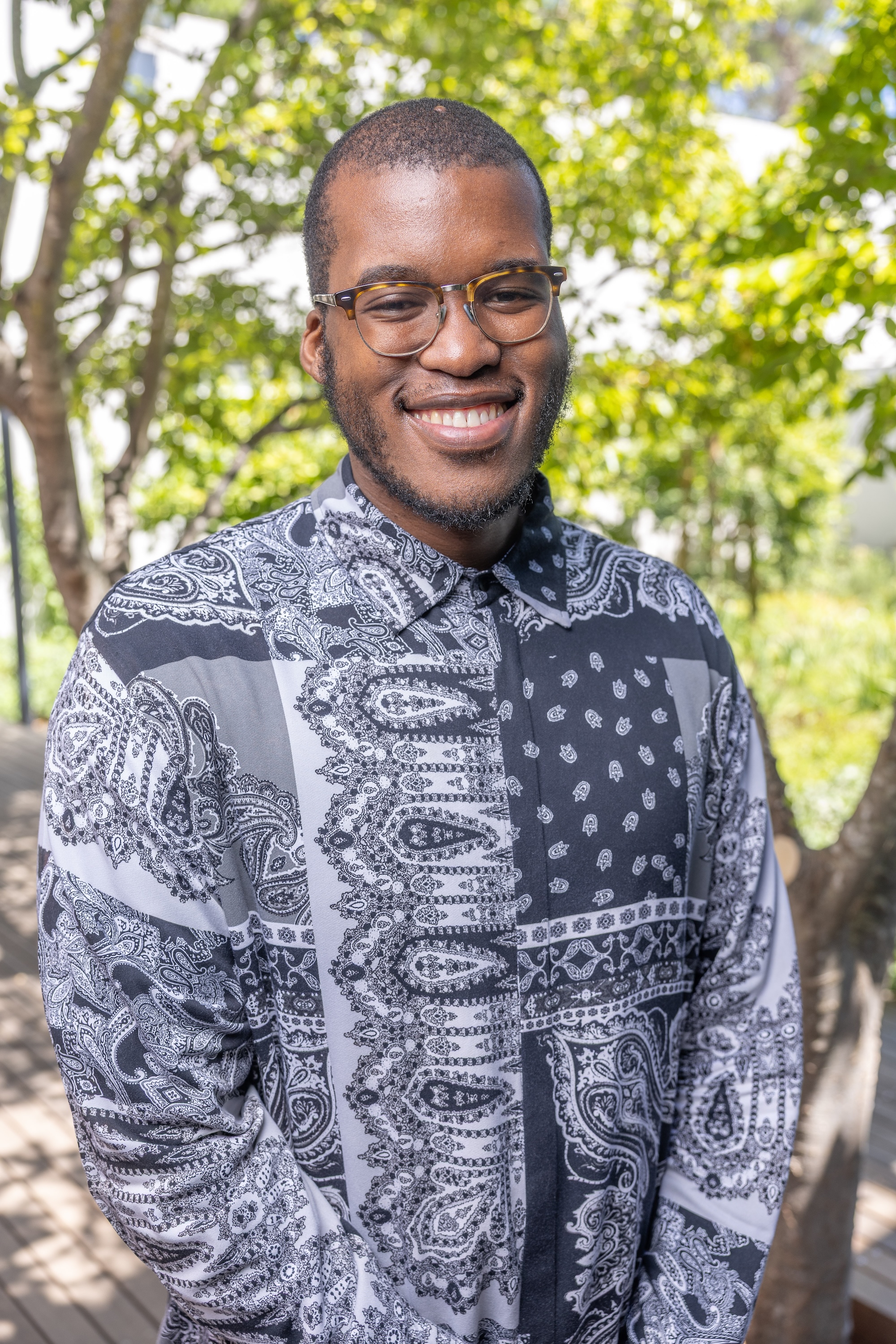
“My STIAS book project, ‘This house is not for sale’, examines the meaning and value of the Black family home in South Africa. Focusing on struggles over family homes in Soweto, I ask a foundational sociological question: What is a Black family home? Rather than approaching this through housing policy or urban development, I situate the Black family home within South Africa’s longer histories of land dispossession and spatial regulation, making the case that these histories fundamentally shape the meaning and value at stake,” said Iso Lomso fellow Mbuso Nkosi of the Department of Sociology at the University of the Witwatersrand.
Nkosi began by describing STIAS as a great space, not just for the mind, but also for the spirit. “I think there's something that has changed within me. I've met not just brilliant minds, but brilliant human beings who are humble. And it’s that humbleness that inspires something within me to know that no matter how much knowledge one has, one is still human and connected to something great. I appreciate you all for that.”
He also started by reading a poem which he described as a greeting from home.
“Overall, as a sociologist, I’m interested in the question of what is a black society,” he said. He explained that his first book – These Potatoes Look Like Humans: The Contested Future of Home and Death in South Africa looked at this question specifically from 2015 when there was a return to the question of land expropriation without compensation in South Africa which was critiqued in terms of restitution, redistribution and tenure reform.“The part on tenure reform said that people living on farms for more than 10 years, could not be removed because that had become their home. But, if you read literature in South Africa, you find that more and more farm workers have been removed, even if they've lived on farms for more than 30 years. So, there's been a failure to attend to this question of land.”“I was attempting to say that being a Black person in South Africa is not grounded, that the various laws in South Africa have removed a sense of being grounded for Black people, and asking how does one ground a concept of society?”
His project will take these ideas further. Nkosi admitted that the idea was not entirely his own and came from a conversation with his mother’s younger sister (uMamncane) who pointed to the growing phenomena of people painting signs on houses in Soweto, Johannesburg saying ’This house is not for sale’ to indicate contestations around home ownership, and told him he was capable of writing something about this. “I saw this as Ukuthunywa (to be sent) which I view as my axiological intervention in this work.”
“I grew up before cell phones when elders used to deliver messages via children,” he added. “The process of delivering messages was seen as an important moment, because the child is seen as an extension of the society and its values. So, I’ve been asked to deliver a message.”
“But,” he said, “Soweto is my home. I'm not coming in as an outsider. The community that made the person I am is the home, my home, my socialisation. And through that socialisation, there is also a sense of community. All of this is enmeshed in how I approach knowledge. And this is how I approach ‘This house is not for sale’.”
Historical roots
Nkosi traced the historical relationship Black South Africans have had with land in townships, and how this reveals complex social meanings beyond property ownership. He also pointed to the distinction between house and home, asserting that the struggle over family homes is not just about the physical structure but about deeper meanings of belonging, continuity and inheritance—"rooted in natal, ancestral and moral ties that connect generations through the home as a site of birth, living, and death”.
“It means looking at the cycle of life and death. When children are born in Africa the umbilical cord is returned to the land. When they die, the person is returned to the land. There's always that relationship, and that relationship is spiritual,” he said. “I'm seeking to understand not about the Black family house but about the Black family home.”
“By foregrounding this distinction, I’m problematising interpretations that read the struggle over family homes simply as an urban housing struggle. Instead, it asks what becomes visible when the concept of home is taken seriously in the context of South Africa’s history of dispossession. In doing so, I argue that the defence of the Black family home reveals deeper questions about value, belonging and the enduring consequences of land dispossession in South Africa.”
Nkosi explained that he started his research in Orlando – a suburb of Soweto − with local historian, spiritual elder and living archive Mkhulu Xaba who described the phenomenon of ‘This house is not for sale’ as a fight to preserve the soul of native land, life and tradition. “He called it Impilo Siko which blends spirituality, community and moral duty, and travels with people. Home is more than property, it is a sacred place, a centre for belonging, a place for the living and the ancestors.”
“My objective then is to write what I call a spiritual biography of the land.”
He explained the problem “which starts with the fact that about 60% of South Africans don't have a person to a thing relationship. They don’t have ownership of the spaces they live in. This is 36 million South Africans. and the majority are Black. They are found in backrooms, in shacks, on farms, on communal land and in rental spaces.”“But, I suspect, if you go deep and ask them about their home, they will have something to say about home, even though they don't have a relationship of a person to a thing.”“We need an alternative solution that recognises the social and off-register processes of tenure and the local systems that integrate custom, and the various ways that people relate to the land. I think ‘This house is not for sale’ forms part of these questions but also moves beyond them.”He traced some of the history of Soweto which emerged from laws of segregation from the 1920s onwards but specifically the 1950 Group Areas Act which removed the ability to own property. “All these laws were to curtail, enforce influx control and the idea of homelands, and create a divide between cities and rural areas.”
In the 1980s the government attempted to create a black middle class leading to some privatisation of state-owned houses. After the democratic transition the process of land registration began leading to long debates about male inheritance and family-owned homes, and often resulting in no clear title deed ownership which has led to problems and nasty disputes in selling properties. “This is why people spray paint ‘This house is not for sale’ on houses,” explained Nkosi. “It communicates to potential buyers that there are problems, but sometimes the house is already sold.”
Biographies of home
Nkosi pointed to another STIAS fellow, Amanda Hammar, and her concept of speaking houses “which focuses on the speaking house in relation to state-making of personhood and citizenship. I'm interested in her method which she calls a biography of building.”
“I like the idea of a speaking home instead and a biography of home, because the home, I think, exceeds the structure,” said Nkosi. “People travel with their homes. There's always a question of gathering. There's always a question of community.”“Home does not derive its authority from legal recognition. One might possess a house and yet remain estranged from home. Conversely, one may be dispossessed, displaced, or rendered illegal, yet remain bound to home through a relationship that precedes and exceeds judicial recognition. It is not the house that speaks continuity into existence, it is the home that calls continuity into being. A house may decay, or be destroyed, but the call of home persists. And this persistence locates the site of continuity from the house to the land. And the land becomes a medium to which continuity persists across generations. It carries the traces of the past and the conditions of future existence. It sustains the horizons to which hope is directed,” he concluded.