
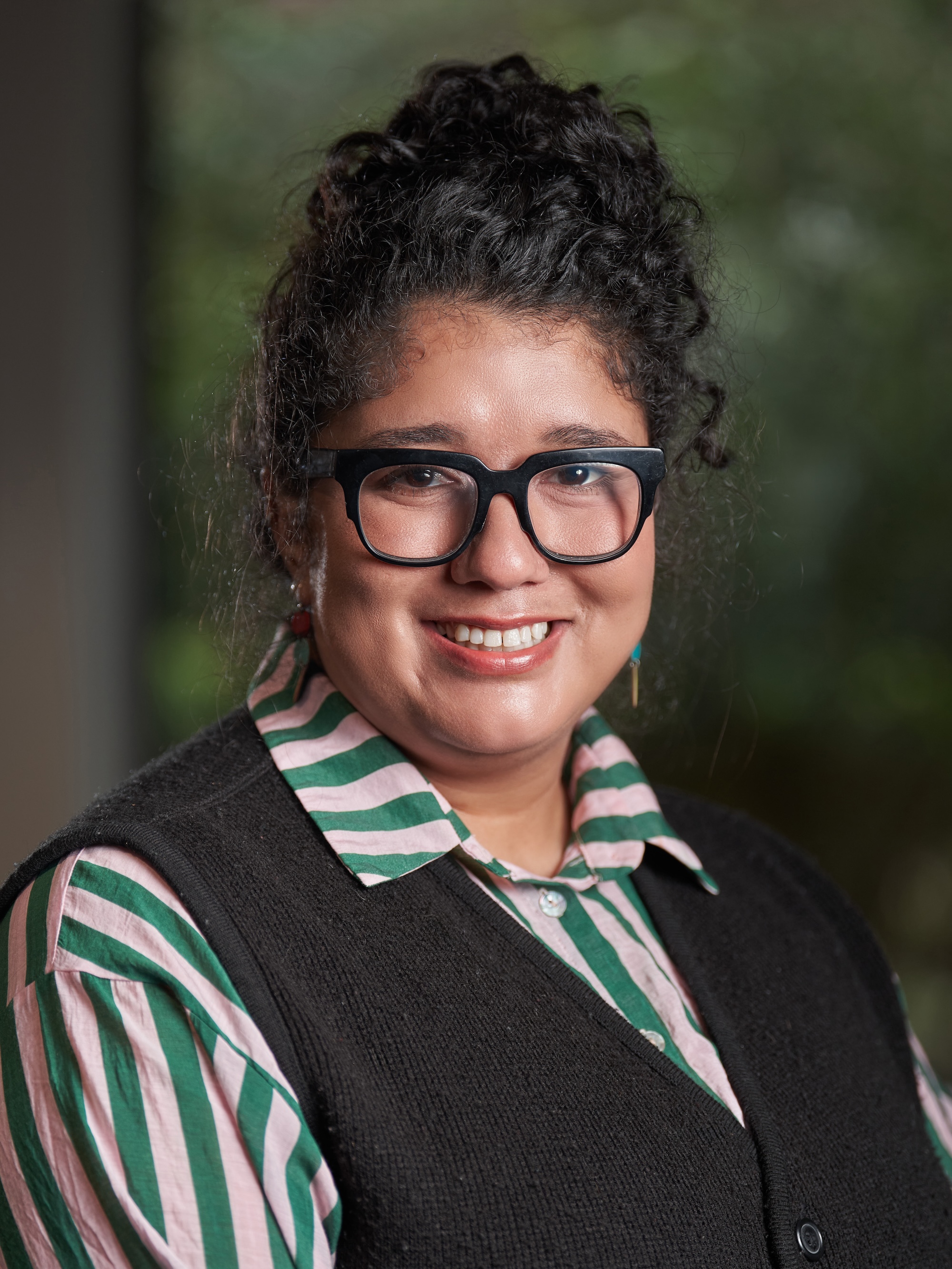
More than a third of the South African population receives social grants, Iso Lomso Fellow Natasha Vally said in her final residency seminar. Her research has traced the evolution of the social-grant assistance payout system in South Africa.
Vally, from the Department of Sociology at the University of Cape Town, examined how South Africa’s social-grant system has become a key site for understanding the relationship between welfare, technology, privatisation and data. She argued that technological interventions in welfare are never neutral: they reshape citizens’ access to the state, produce new forms of waiting and exclusion, and create opportunities for private profit through the extraction and monetisation of data.
“This seminar explores possible paths for thinking technopolitics through a present-day reading of 15 years of research around the hardware, software and sociality of grants,” she said. “I discuss the way that South Africa is positioned as the place for ‘piloting’ and spreading technologies. The research also unravels strands of work that engage thinking of data as capital.”
She explained that in 2012 the South African Social Security Agency (SASSA) contracted a private company, Cash Paymaster Services (CPS), a subsidiary of Net1, to design a standardised national social-assistance infrastructure. The system was promoted as the epitome of technological progress and innovation, with substantial use of biometrics.
“The service was seen as merging universality with local conditions and was supposed to herald a healthier future of inclusion,” explained Vally. “However, these efficacies didn’t materialise, and as early as 2014 there were incorrect deductions from 2.3 million of the 10 million bank accounts into which grants were paid.”
“Over time it became clear that the system caused further and different possibilities for fraud, theft and inconvenience, and new kinds of waiting for claimants.”
Vally also pointed out that CPS employees were actively getting people to take loans at grant-payment sites. These were immediately deducted from the grants, exorbitant interest rates were charged, and there was no risk to the provider. Similar tactics were used for airtime and electricity purchases as well as life insurance and funeral policies. Use of the same machinery and staff lent legitimacy to these activities.
“Over time the systems eventually led to fewer direct opportunities for direct recourse as the privatisation distanced people from the state and even diluted collective action,” she said.
Despite Net1 and CPS being taken to court multiple times, the company’s extensive infrastructure and footprint across various sectors meant they could continue for a long time despite any court rulings. They continued to provide the service until 2018 when it was moved to the Post Office. But although Net1 handed over the data to the Post Office, they kept a copy and have continued to use it.
Vally pointed out that the information and data gained by the company was worth far more than the original contract. “The data was not only facilitating profits but could be understood as capital itself. People broken into bits become invisible but encodable.”
She also emphasised the impact of the COVID-19 pandemic in 2020. “Lockdown meant that information had to be provided online and in digital format. The introduction of the Social Relief of Distress grant also heralded a new understanding of what a grant is. Within three days, 3.5 million people had applied for it; it was paid to 5.3 million in 2020, by 2022 10 million, and even more today.”
Shifting perspectives
Although Vally hopes that others will continue to document these events in detail, she explained her perspective is shifting to trying to reach an overall understanding of the broader impact of such technopolitics on society, economics and politics.
“I want to think about what the promotion of technology produces. What our commitments to technological improvement are doing in this place? Why South Africa? Why here? And what it actually means when we advance a particular software or technological development on an unjust system.”
“We have to acknowledge that people in the Global South already live in the future,” she continued. “New technologies are often rolled out in developing countries and often on people who have little choice – in this case, the only choice is getting the grant or not, and that means complying with the system.”
She argued that data should be understood not merely as a by-product of welfare administration, but as a form of capital. “Grant recipients are rendered as data subjects whose biometric, financial and behavioural information can be used to expand commercial markets,” she explained.
She also believes we need to understand these developments within South Africa’s longer history of racialised data collection, privatisation and technological governance, while also connecting them to current debates on artificial intelligence, digital infrastructure and the country’s role as a testing ground for new technologies.
She emphasised that technological development has been connected to aspiration, efficiency and progress, and in post-colonial countries even to possibilities of freedom, ways to address social ills and the possibility of a better, more just future. “However, promises of efficiency, inclusion, fraud prevention, and technological progress often obscure the deeper political consequences of outsourcing state functions to private companies.”
“We are also given the impression that the present will be fixed in the future by more technology,” she added. “This delays criticism.”
Overall, she called for a more critical, historically grounded approach to welfare technopolitics emphasising that instead of accepting technological ‘improvement’ as inherently progressive, we need to unpack the kinds of political relationships, subjectivities and futures being produced through these systems.
“These systems are doing a lot of things,” she said. “They are actively distancing people from the state, the potential for recourse and having a say and therefore the shaping of democracy. They are also advancing particular kinds of rationalities – for example, what it means to be a good citizen. Lots of new technology is actually repeating old technological and socio-political practices.”
“I’m also trying to think of data from its earliest forms and coming back to what it means to gather data for beauty.”
Article: Michelle Galloway
Photo: Curt Ruiters, Quickclick Productions