
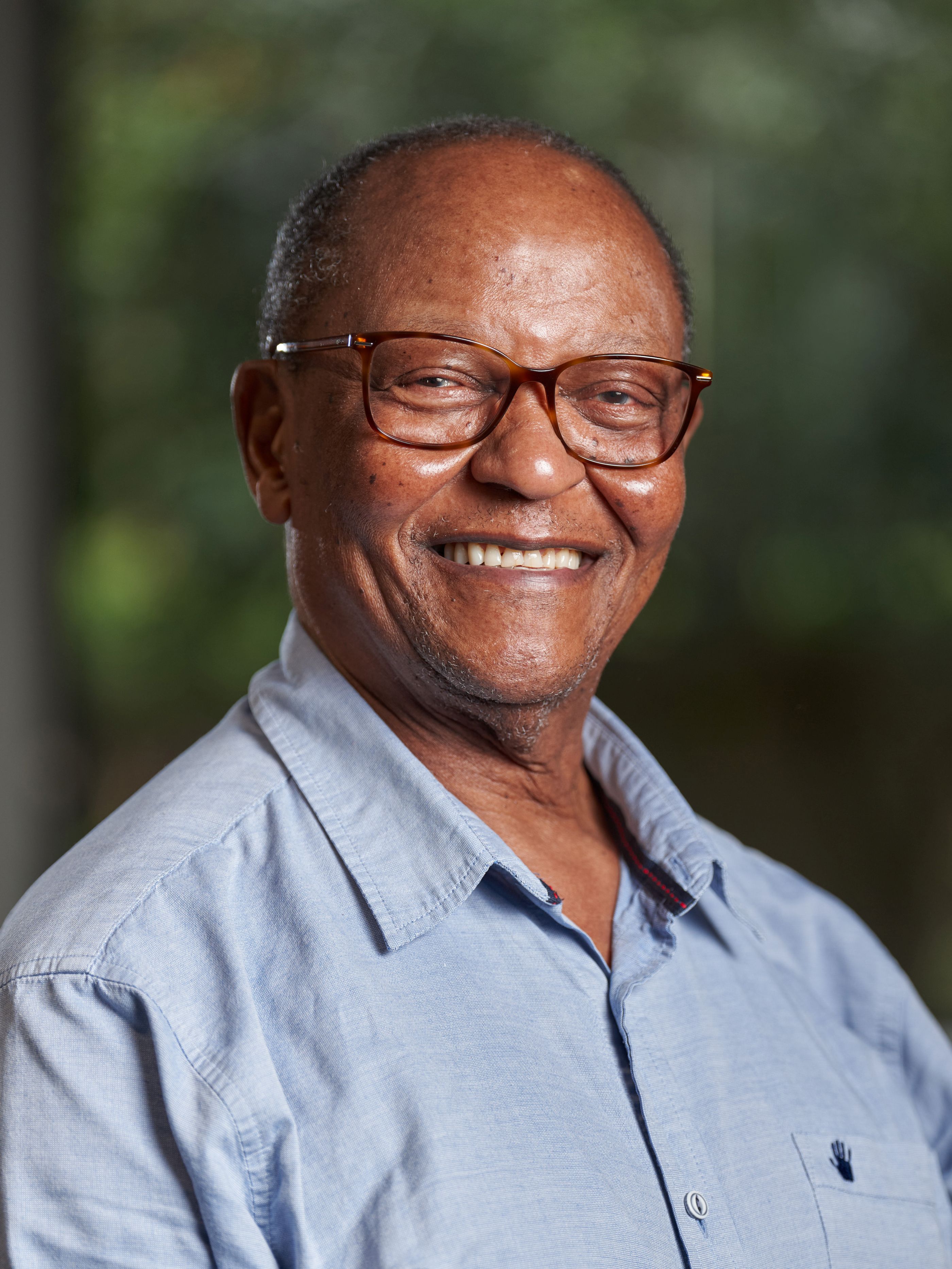
Acclaimed scholar, public intellectual and author Njabulo Ndebele is spending time at STIAS writing his next novel, an anticipated addition to his impressive repertoire of writings about the effects of the apartheid regime on black communities, the rhetoric of protest, democracy and the South African higher education system.
Tentatively titled The Killing of the Dogs, the book is in its early stages. In his seminar, he shared the creative thinking process behind the book.
“My primary goal in the residency is to plan the story more in its visualised outlines than in the detail. Sometimes parts of the story are visualised without being written. Some, once visualised, call out to be written down. In that case, speed in capturing in note-form the scene or a sequence of action in the story becomes vital," he said.
Opportunities to capture ideas and sequences of action in a narrative in the making do not always arise. "In that case, unfortunately, many feelings, thoughts, and sensations of fleeting experience, in their transitory lifespan, have simply evaporated,” he said adding that flashes that have survived the transitory moment of their origin were those lucky enough to have been written down in memory notes.
"I have learned along the way to not mourn the loss of what I instantly forgot. In the plenitude of life, other flashes of visualisation have always come along. What gets lost will, in some way, be replaced by something else that comes along with its own fascinations. This is the treasure in what constantly comes and goes in the universe,” Ndebele said.
He described fiction writing as one of may ways of talking about something. "It all comes from the imagination – we create something that wasn’t there before, but based on something that was there before that we interpret differently," he said.
The book is the first one he is tackling as one big novel as opposed to a long short story. “It’s a daunting task. I’ve never tackled anything as complex. I also haven’t shared the intimacies between the writer and writing before. The process and activity interact internally. It’s hard to share the experience without losing the magic. Talking about an idea risks it dying," he cautioned.
In unveiling the mystery of the creative process he warned that writing is not always an enjoyable process for the writer. "You are subjecting yourself to a great deal of endurance and discipline.”
“Creative writing is about contemplating human experience, explaining an idea through the experiences of people – their anxieties, fears and doubts − and how they try to resolve these on a day-to-day basis", he said.
Ndebele's academic career includes serving as Principal and Vice-Chancellor of the University of Cape Town and Chancellor of the University of Johannesburg. He has also served as chairperson of the Nelson Mandela Foundation and the Mandela Rhodes Foundation for over two decades. His literary works, such as the Noma Award-winning Fools and Other Stories, have profoundly influenced South African literature. His involvement with STIAS dates back many years, including being a member of the Effects of Race group project.
No accident
Ndebele said some of the major influences on his writing life included rummaging through his father’s book collection, manuscripts and notebooks during school holidays as a child.
“I would explore the house and I found a big box of banned books in my father’s garage. I was both shocked and proud. I read them and they changed my life. I was dipping into the illegal and keeping it secret," he said.
He also discovered the early manuscript of the first book published in isiZulu in 1945 by his father, Nimrod Njabulo Ndebele titled, Ugubudele namaZimuzimu which he described as “an infinitely proud” moment.
“What we become has a lot to do with how we grew up,” he said. “In my case it was with books and manuscripts. It was no accident I ended up the same way. We are all products of what has gone before.”
“I’m grateful to things that may only mean something a lot later in life,” he added.
Another formative decision was to go to the University of Denver in Colorado to do a PhD in Creative Writing. “It was a wonderful experience,” he said. “With intense study of many great writers – including Joyce and Beckett – who were all pathfinders, inventing newer forms.”
“I must admit I gave up in Finnegans Wake,” he laughed, “but found Ulysses beautiful.”
Other classics that resonated included Thomas Mofolo’s Chaka; Albert Camus’ The Plague, Fyodor Dostoevsky’s The Brothers Karamazov and Leo Tolstoy’s Anna Karenina.
Ndebele credited his 1983 short-story collection Fools and other Stories as having come directly from these classes.
“In the weekly seminars we would read and critique,” he said. “I learnt more from the criticism than the praise. I learnt nothing is ever perfect; to be humble; to take criticism and to give and take.”
Something he has carried into the sometimes harsh world of literary critique.
“I read reviews, but I don’t let them determine my reaction to the quality of the work I’ve done. Sometimes reviewers get it wrong. It’s never about you but about whether you are skilfull enough. You the writer must be separate from you the individual. You learn from both good and bad reviews. It’s important that someone took the time to read your work,” he explained.
And does he believe that creative writing must be taught? “I think you have to have a natural inclination, but it is useful to be subjected to rigorous discipline around how to do it better. Both together are huge benefits.”
However, he believes emphatically in the absolute importance of preparation – the stage he is at now for his current work.
“Preparation is critical,” he said. “You have to have the sense of place – so that the reader can smell, hear, feel, taste, touch – indulge all the five senses. You need to spend time in the storyland of writing.”
“It’s a detailed thing. You have to account for the setting – buildings, churches, schools − and for what the characters do, their habits, their way of living. You work with character types and their impact on the place which can alter the sense of self. In writing fiction you can’t avoid painstaking detail. For example, I have had to study a lot about dogs for the forthcoming book," he said.
“I believe you can address very complex issues of society by telling a story instead of adopting polemics or politics directly,” he added.
And his closing message – “If you are thrown a stereotype, throw back a complexity. Complexity never fails to undermine stereotypes.”
Article: Michelle Galloway
Photo: Curt Ruiters, Quickclick Productions