
As part of a larger project on the relationships between space, race and gender in Afrikaans literature, Iso Lomso Fellow Bibi Burger of the School of Languages and Literatures at the University of Cape Town discussed how the rapid changes and concomitant hopes and anxieties of apartheid’s end were represented in writing by white Afrikaans women.
She focused on how these societal fissures and affective orientations were figured spatially, in experimental novels and short stories that reclaim the home from its traditional role as domain of the Afrikaner volksmoeder (‘mother of the nation’), as well as in texts that imagine and portray a venturing out of the predetermined material and imaginative limits placed on white Afrikaans women.
“My project has changed since my application to STIAS,” she said. “I originally aimed to investigate the role of race in how feminism manifested in Afrikaans literature. I am still interested in this topic, but my thinking on it has taken a spatial turn. I tend to look at the world in spatial terms, but I think it is for the good reason that South Africa’s apartheid and colonial history is very much influenced by geographical thinking, and its literature marked by recurring themes of displacement, ownership and belonging.”
The project will result in a book. The chapters thus far include one examining plaasromans (farm novels) which Burger (after J.M. Coetzee) described as holding an almost mythical place in Afrikaans literature and which largely explores land and loss, often justifying the white Afrikaner relationship with and ownership of African soil. Burger’s approach to this topic is to look at the role of women in traditional plaasromans, as well as to investigate how contemporary black feminist novels by writers such as Engela Ovies, Audrey Jantjies and Ronelda Kamfer challenge dominant perspectives on the farm.
She explained that feminism in South Africa was largely figured in white terms until recently: “The first Afrikaans novel by a woman of colour was E. K. M. Dido's Die storie van Monica Peters published in 1996 and the first book of poetry was Ons komvandaan by Diana Ferrus, self-published in 2006, in which she situates herself within the global black diaspora.” In the last chapter of her planned book, Burger argues that Ferrus’s collection itself functions as a type of ’komvandaan’ (heritage), making space for the black feminist Afrikaans poets that came after her.
Burgers' daughters
For her final Iso Lomso seminar, Burger focused on Chapter 3 − provisionally titled “Burgers’ daughters” (after Nadine Gordimer’s 1979 novel), which investigates white Afrikaans women writers writing during the state of emergency in the 1980s. It will cover texts written between 1975 and 1995 and emphasise how spatiality featured in the writing.
Sketching the context, Burger explained that according to sociologist Jonathan Hyslop, between 1948 and 1976 many white Afrikaners achieved rapid economic success, resulting by the 1970s in a large Afrikaner middle class driven by consumerism rather than primarily by ethnonationalism.
“But politics, society, culture and psyche were also impacted by the so-called Border War which was a misnomer anyway,” she said. “While white South Africans could largely live in ignorance of the violence of apartheid, between 1967 and 1994 there was military conscription of all young white men, which affected families and individuals, especially those posted in the townships and essentially fighting other South Africans.”
“This led to the prominence of grensverhaal (border stories) from authors including Koos Prinsloo, Alexander Strachan and Etienne van Heerden, which were wide-ranging in style and politics.”
Burger explained that over time there was increased consciousness about the realities of apartheid and changes in the views and lifeworlds of white Afrikaans speakers. “Afrikaner nationalism began to lose its persuasive power,” she said. “In this crisis of hegemony and shifts in reality there was a rise of a new experimental Afrikaans literature informed by international trends and post-modern literature.”
Of course, the apartheid state tried to curb this, and Andre P. Brink’s Kennis van die aand was the first to be banned. However, his supporters raised funds to publish his next book, Oomblik in die wind, which led to the establishment of the underground publisher Taurus, which would go on to publish many countercultural books that would otherwise have been banned or censored by the Nationalist government.
“Although many writers of the period were women, their work was still largely marginalised even within ‘alternative’ literary spaces, and today remains underinvestigated,” said Burger, even as these texts were described by some critics as the new avant-garde of Afrikaans writing.
She explained that although these works have important political implications, these writers tended to be self-critical and not necessarily critical of the state. “But this must be understood against the background of the hegemonic culture,” she added. “The feminism that did exist in mainstream Afrikaans literature was heavily invested in nationalism and what some call racial uplift feminism.”
“The repurposing of domestic, traditionally considered feminine, spaces was typical of experimental feminist art of the 1970s and 1980s globally, although how it manifests in Afrikaans novellas of the time is specific to the changing South African,” she continued. “These novellas can be considered female grens (border) literature in which the border war and deployment of the military in townships were brought inside the kitchen and home.”
Burger believes the experimental literature by white women writers in the decades under consideration gives important insights into how these writers saw and positioned the white middle class in private and public spaces, as well as in the broader human and more-than-human world.
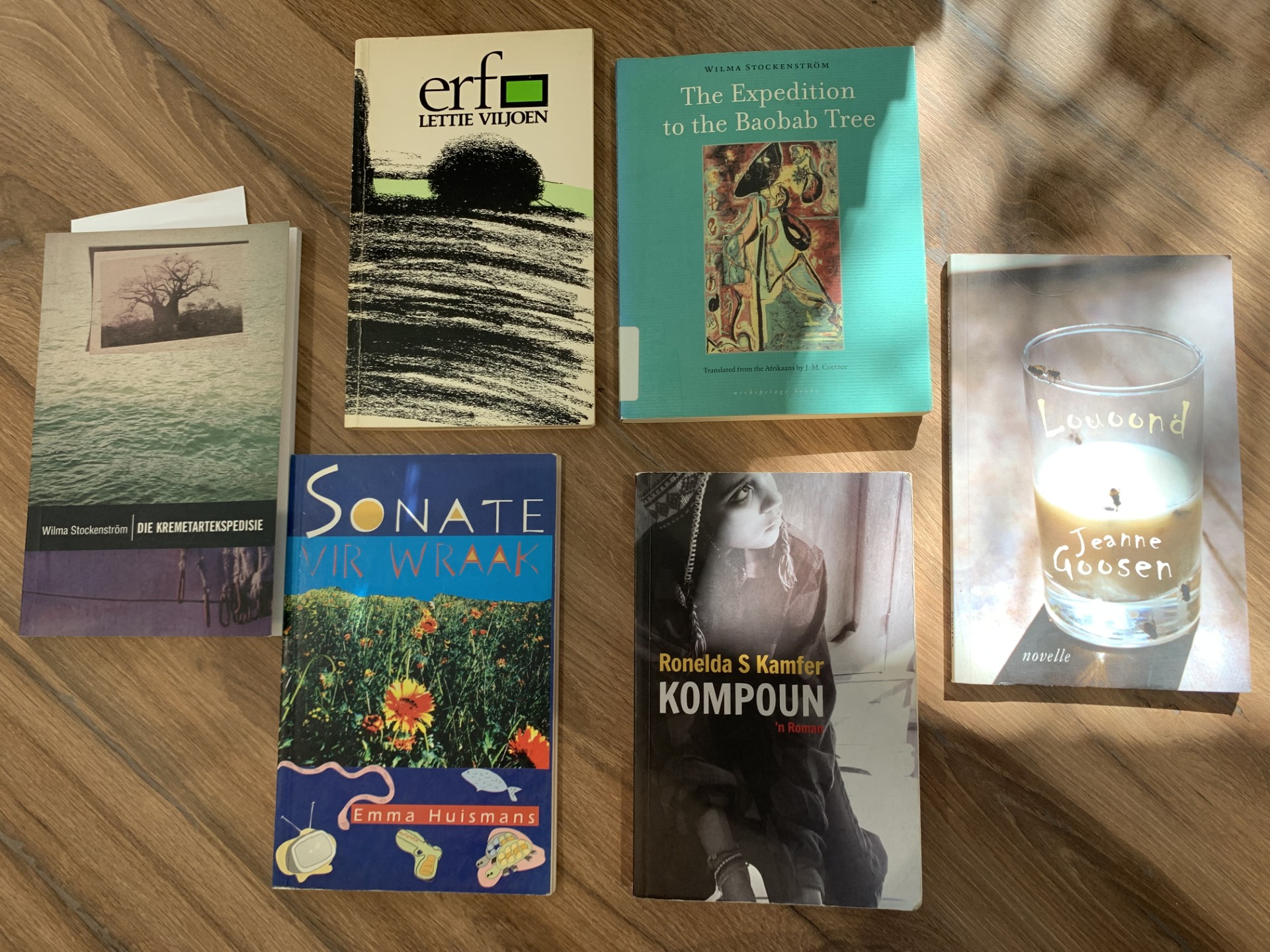
Some of the books and authors she focuses on include Erf by Lettie Viljoen, Louoond by Jeanne Goosen, Sonata van wraak by Emma Huismans, Melk by Elsa Joubert, and The Expedition to the Baobab Tree by Wilma Stockenström, which was translated into English by J. M. Coetzee.
Burger explained that as the myths of Afrikaner nationalism began to crumble during the last two decades of apartheid and the site of war shifted into black townships, these women writers depicted the reconfiguration of habitation, both on the level of the nation and the individual household, and the resulting loss of certainty, as well as a desire for a new world, even as very few of them considered what practical actions would be necessary to make this new world possible.
“Although the encounters with the racial other are generally inward-driven and from the perspective of white Afrikaans women, such descriptions express a wish to transcend apartheid’s limits and begin to focus on the need to change,” she said. “Where some white women writers can rightfully be criticised for speaking for a black character (such as in The Long Journey of Poppie Nongena by Elsa Joubert and The Expedition to the Baobab Tree by Wilma Stockenström), I agree with Ksenia Robbe that they still centralised the black woman in a literary tradition that historically negates her, and opened up the possibility of reimagining race and gender relations.”
“I want to explore the depiction of intimate and political subjectivities,” she said. “These women writers lived through a time when the structure of thought and geography was changing in real time, even as many oppressive social structures ultimately tragically endure into the present.”
“White South African women’s empowerment in the decades under discussion was still tied to the suppression of others,” she said. “But there was a contradiction because the more economically powerful they became, and the more exposed to the world outside of South Africa’s borders, the more they began dreaming of a life beyond apartheid.”
The period also saw an explosion of Afrikaans queer literature.
“Koos Prinsloo, to take a prominent example, was one of the first openly gay Afrikaans writers. Compared to gay male writing, the lesbian tradition in Afrikaans literature has been submerged and not historicised. I am also looking at some of the lesbian writers from the period – and their attempts to find a space for queer belonging in apartheid South Africa.”
Article: Michelle Galloway
Photos: Curt Ruiters, Quickclick Productions and Bibi Burger