
One third of humanity has never sent an email, loaded a webpage, or accessed a digital service. Behind that statistic lies a geography of exclusion that is neither accidental nor inevitable. In fact, it is the predictable outcome of technologies designed for markets that rural communities in the Global South were never a part of.
“The digital divide has kept these communities at the periphery of the information age. The AI divide threatens to make that periphery permanent,” said Jean Louis Fendji.
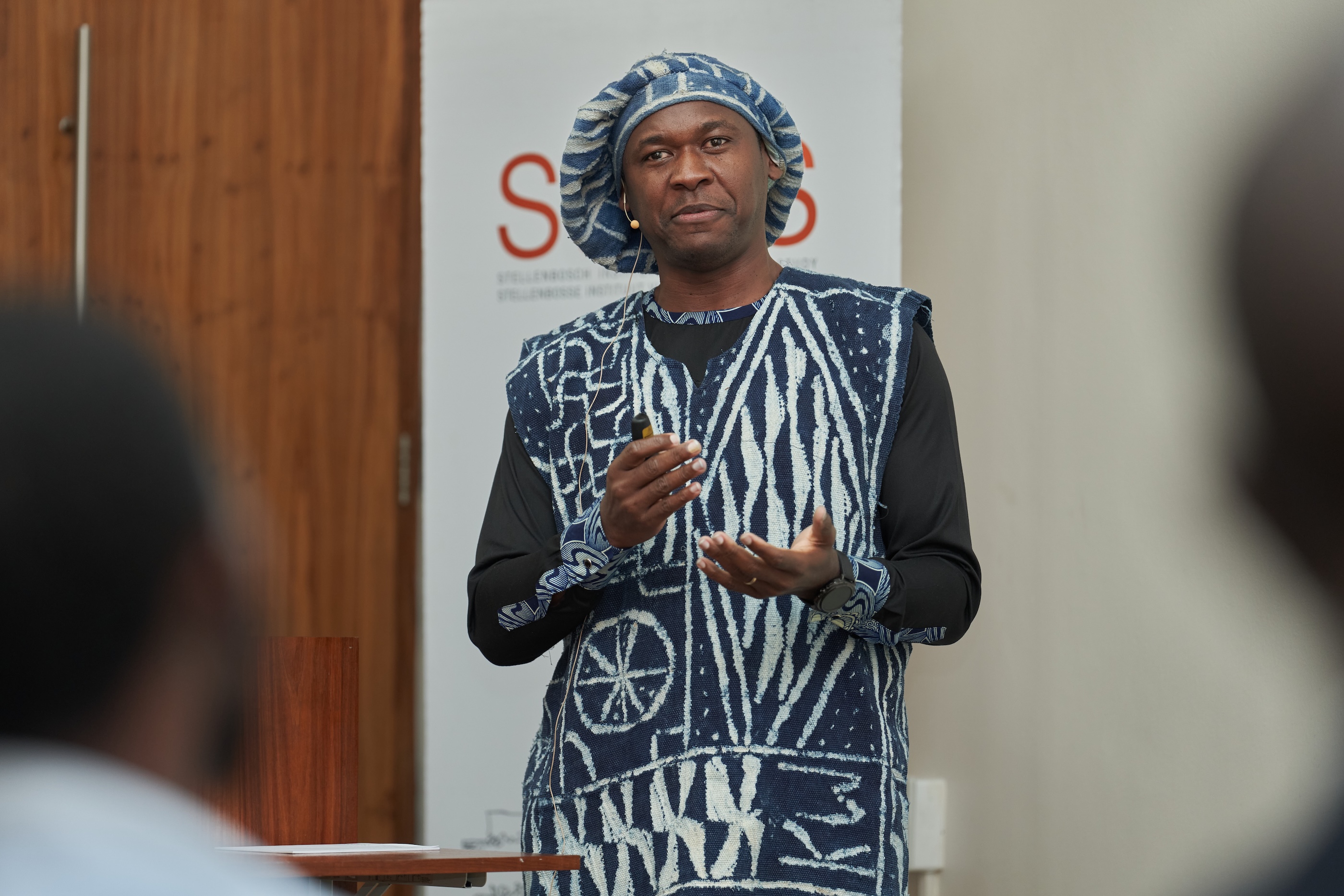
Fendji was speaking at the second STIAS Public Lecture of 2026, where he emphasised that 2.2 billion out of 8 billion people have never had access to the internet. In 2005, 16% of the global population was online; by 2025, the number increased to 74%, but in Africa, only 36% of the population is online. “This is not accidental; the exclusion shows colonial-era infrastructure deficiencies. It’s not a technical problem but a design and political problem,” he said.
He also pointed out that many of those connected were at the first level of basic internet use. “Meaningful access means regular access, appropriate devices, enough data, fast connectivity and security.”
“Lack of connectivity is not passive; it actively harms people,” he continued. “Connectivity is a precondition for accessing any online service. And AI makes the cost of not being connected exponentially higher.”
“Unlike the digital divide, which could in principle be closed by ‘extending infrastructure’, the AI divide compounds itself. It feeds on data,” he explained. “Consequently, the communities least connected are the least represented in the datasets that train the models now reshaping education, agriculture, healthcare and governance. Absence from the internet becomes absence from AI, which becomes absence from the decisions AI is increasingly being trusted to make. For rural areas across sub-Saharan Africa and the broader Global South, this is not a future risk. It’s a present reality.”
Jean Louis Fendji is an Associate Professor at the University of Ngaoundéré, where he heads the Centre for Research, Experimentation and Production at the School of Chemical Engineering and Mineral Industries. He holds a Dr.-Ing. in Computer Science from the University of Bremen, Germany.
His research sits at the intersection of AI and ICT for development, with a focus on leveraging AI and optimisation techniques to address sustainable development goals in rural areas. Over 15 years, his work has spanned wireless mesh network design, automatic speech recognition for low-resource African languages, AI governance frameworks, and the study of generative AI bias and its consequences for unconnected communities. He has authored over 45 peer-reviewed works and has been involved in numerous projects funded by the Global Partnership on AI, the European Union, German Cooperation (GIZ), the DAAD, the Internet Society (ISOC), and the Association for Progressive Communication (APC), working across numerous African countries.
He is a STIAS Iso Lomso Fellow and a former Fellow at the Hamburg Institute for Advanced Study. He is a member of the AI and ICT Commission at the Ministry of Scientific Research and Innovation in Cameroon, and Co-Principal Investigator of the EU Horizon DIGITAfrica project.
In the lecture, Fendji highlighted concrete efforts from his own and others’ work to build community-owned networks in Africa; to design agricultural and educational AI tools that begin from what rural users actually have, not from what urban designers assume; and to develop technologies for communities whose mother tongues have no meaningful presence in existing AI systems.
“What if the margin is not an afterthought but the starting point from which responsible technology becomes possible?” he asked.
“Getting there is physically not easy. Systems are built and designed for markets in urban areas. At the margins, with their sparse populations and lack of grid power, it becomes an expensive investment. But the data at the margin is irreplaceable,” he said.
From communities
One approach to improve this situation has been the development of community network models in Africa (like Guifi-net in Spain and Zenzeleni, South Africa’s first community network). For his PhD, Fendji was involved in developing a community network in Cameroon that connected 6000 people from three rural localities. He also led the development of a regulatory framework for community networks in Francophone Africa, with the support of APC and ISOC.
But he noted the need to ensure that the emphasis remains on the community and its needs. “The Internet is good,” he said, “but relevant services are better.”
Fendji is involved in developing innovative AI interfaces that take cognisance of local realities. He highlighted projects in the education sector seeking to deliver information. This includes the SONIC project, led by New York University Abu Dhabi, which aims to repurpose AM/FM radio to deliver pre-rendered webpages. “The data are transferred over sound and radio networks to reach large numbers of users. The testing has been conducted in Cameroon,” he said.
He also spoke of the vital agriculture sector. “Sub-Saharan Africa holds 60% of uncultivated arable land and 80% of the rural population, but we need to increase productivity,” he said. “We have worked with farmers to identify their needs while also paying attention to resources, culture, purchasing power, credit risk and loans.”
His STIAS project looks at the language aspects. Africa has many languages – many of which are endangered – for example, in Nigeria there are 520, in Cameroon 273 and in South Africa 20. And AI doesn’t ‘speak’ or include most of them. He is therefore investigating the possibility of using an African oral language in an offline, voice-based form using mobile phones.
“We are looking at automatic speech recognition using a limited vocabulary. We are hoping to train a domain-specific model so that data in low-resource languages can be collected via a community-based app and using only small amounts of data,” he explained.
Fendji also passionately spoke of the need to rethink data justice, to empower access to and use of African data through equivalent licensing, to reimagine sustainable dataset management, and to raise awareness in marginal communities and with decision makers.
“We also cannot overlook things like e-waste, the water stress and environmental impact caused by data centres, and critical mineral extraction.” To this end, he is working on a framework to estimate the true cost of AI projects. In addition, he is participating in the DIGITAfrica project that aims to develop a comprehensive Pan-African infrastructure in digital services. The project addresses key challenges in connectivity and AI within the African context.
In summary, he highlighted the following important takeaways – stressing that connectivity is a governance, not a technical problem; that AI exclusion is structural and compounding, starting from the problem definition and data gathering; and that the margin should be seen as the origin, not the destination. “Technology is currently market first, the responsible approach is margin first.”
“We need services made by local people for their local needs. We need to start by identifying community needs and work from those needs,” he concluded. “It’s better to have small, specialised models rather than one big one that attempts to solve everything but is difficult to sustain. The margin is the starting, not the endpoint.”
Article: Michelle Galloway
Photo: Curt Ruiters, Quickclick Productions