
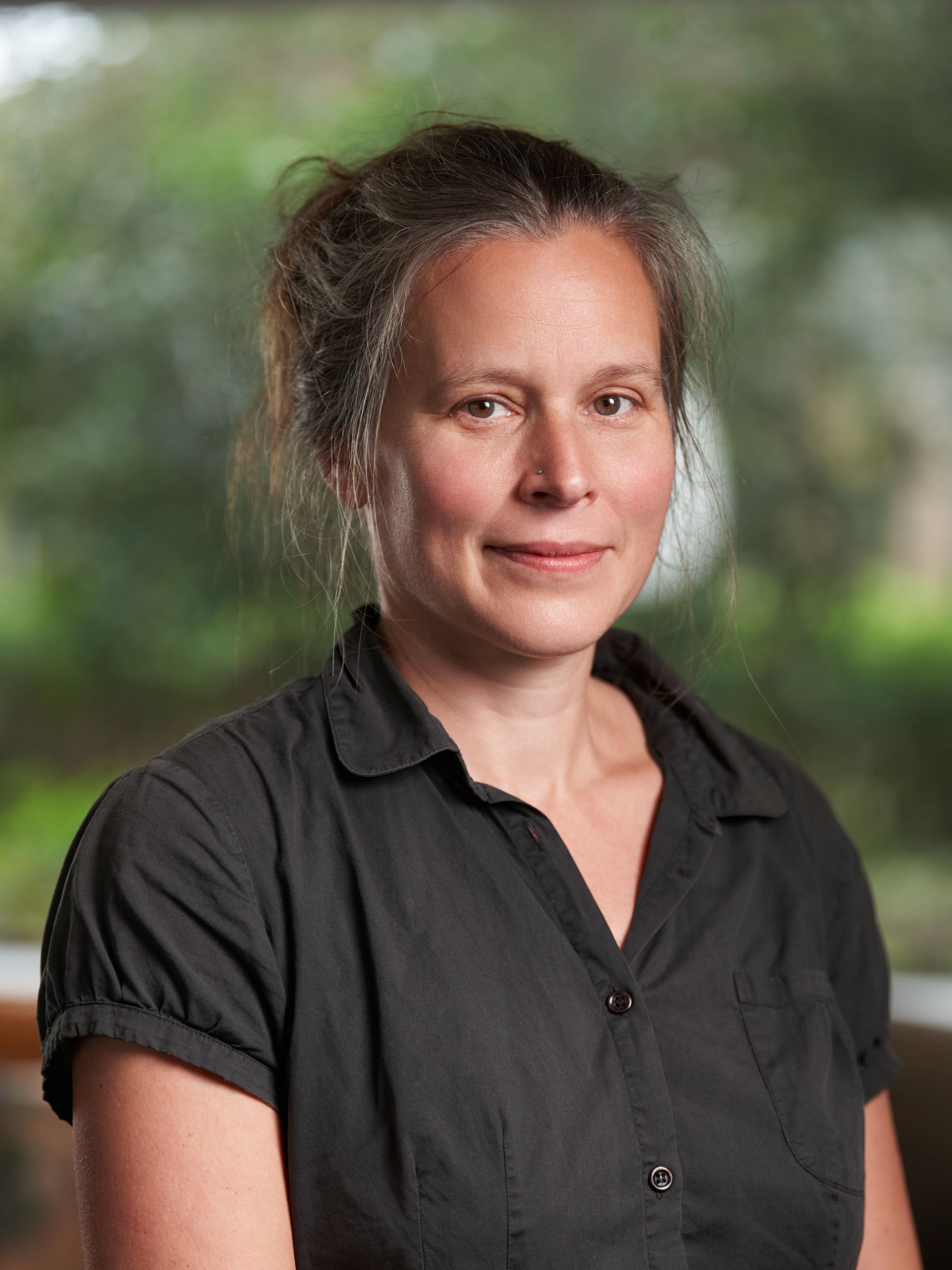
“My aim in this project is to think through different forms of politics and the various political principles that may underpin non-state political institutions and arrangements. I think there is a demand for different kinds of political thought, beyond what now passes as orthodox political theory. Looking at local assemblies serves as my starting point, because they are concrete, observable, and have a long historical record, which means that we can study changes but also continuities over time. They hence make it possible to shift our focus from theory to practice, and from metropolitan theorists to local actors,” said Judith Scheele of the École des Hautes Études en Sciences Sociales (EHESS), Marseille.
Scheele explained that since the 1990s, it has become commonplace to argue that African postcolonial states are ‘failing’. Much less has been said about what happens afterwards: although state provisions in many places on the continent – as elsewhere – are indeed deemed insufficient by most citizens, this does not usually imply a descent into chaos, or the replacement of politics by crisis. Instead, some form of political order is generally maintained or achieved through a complex interplay of local and regional political actors and institutions, in which states are not absent, but are part of a broader and diversified palette of techniques and modes of governance. Although everybody locally knows that this is the case, these complexities are often sidelined in official reports and academic writing, partly because they sit uneasily with the currently dominant vocabulary of political analysis.
Scheele’s book project aims to start from one of these local institutions – local assemblies – in the northwestern corner of the African continent, where she has conducted detailed and long-term fieldwork for the last 20 years, in Algeria, Mali and Chad, to embark on a transregional comparison that will permit us to ask questions like: what can these assemblies tell us about the shortcomings of orthodox analytical vocabulary? Can they throw light on political practice and ideas elsewhere, in a process of reciprocal comparison that eschews reference to Western academic ‘standard’ models? And what, if anything, can we learn from this?
“I’m interested in political practices, ideas and principles, taking ‘politics’ to refer to a form of collective ethics concerned with how to live together well,” she explained. “There are many living traditions of this kind in Africa – and they are not widely recognised.”
“But I am not quite sure about the practicalities of going beyond the examples I know well,” she added. “Should I be looking for similar patterns in different contexts? How different or similar should comparative sites be? Should I concentrate on examples drawn from the African continent, which have remained strangely invisible in much recent writing, and which kinds of settings are conducive to the analysis I would like to propose?”
The seminar aimed to introduce the broader project and to present some of the ethnographical material that underpins it. She started with a site she knows well − Kabylia in northern Algeria, where she started her doctorate. She gave some examples from Kabylia to illustrate the workings and challenges of local village assemblies. This included the assembly’s role in the 2001 riots following the killing of a protesting high-school student, as well as their response to COVID-19, in which assemblies independently gathered funding to bring in equipment and training, offered health care, and policed curfews, thus protecting inhabitants from the pandemic.
These events heightened the visibility of such assemblies on the national level, highlighted questions of exclusivity, their role in protecting local rights, their fraught relationship with the state, and the tensions between inclusivity and exclusivity that frame assembly politics. “The paradox is”, she said, “that most people will agree that village assemblies are a good thing in principle, but that, alas, their own is unfortunately corrupt …”. She noted that this is not anecdotal, but points to a structural feature of assembly politics: once decisions are up to debate, they will be criticised − and this is precisely why these institutions are quite to alive and dynamic. Scheele also pointed to ongoing contestations between the assembly and local administration about land ownership.
Invisible in academic literature
Awareness of and myth-making around these assemblies is not new. “French colonial officers noticed their importance”, she said, “much as the Ottomans had done before them. Nineteenth-century French philosophers held them up as examples of ‘true democracy’, in counter distinction to a French society that was then grappling with revolutionary upheavals and sporadic returns to monarchical regimes. In this process, however, the French colonial regime misrecognised local assemblies as ‘specifically Berber’, turning them into a cornerstone of the ‘Kabyle myth’ developed by the colonial regime to better divide and rule their North African colonies. This has made it difficult to talk about them today, and it also rendered local assemblies among Arabic-speakers, which were historically quite as common as among Berbers, strikingly invisible in the literature.”
“Most of Algeria, as well as Morocco, Tunisia and Libya, has been ruled by such small bodies,” she continued. “They exist on the margins of the states, and the individuals involved are highly literate and schooled, but officially, they don’t exist. In fact, assemblies have been able to survive colonial and post-colonial political upheavals mostly in those areas that are not the most ‘traditional’, but rather the most closely integrated with the international economy, as migrants have long sent money back home to shore up local assemblies. This was certainly the case in Kabylia.”
Despite their longevity and resilience, local assemblies are strikingly invisible in the literature. This is due to French colonial legacies, but also to the way sociology developed in Euro-America after the Second World War, as the study of politics gradually became the study of domination, power and resistance – to the exclusion of bottom-up forms of collective organisation. “It was necessary to get rid of naïve or reactionary notions of consensual and age-old ‘tradition’,” said Scheele. “But an interest in power should not preclude an interest in local political institutions, or in other forms of collective political action: that is to say, we need to account both for power dynamics that shape all aspects of life and for the emancipatory potential of grassroots politics”.
She cited the French sociologist Pierre Bourdieu as an example here, who wrote thousands of pages on Kabylia but hardly ever mentioned local assemblies, not because he hadn’t seen them, but because he didn’t want to see them. “They did not fit in with his conceptual apparatus, so they were dropped. He saw politics as belonging to modernity and had a romantic vision of villages as a traditional society with no place for politics. These kinds of omission happen all the time – indeed, this is how ‘theory’ is built – but we need to be aware of them, to correct theory’s bias.”
The aim of the project, hence, is to find a way of talking about these institutions without romanticising or de-historicising them. She highlighted four questions she hopes to unpack further: inclusion and exclusion – what are the boundaries, who is in and who out; the need to rethink the commons as a political rather than an economic process, or rather to stop dividing ‘the economy’ from ‘politics’; reclaiming the law from its usurpation, real and imagined, by the central state; and, thinking though large-scale decentralised systems.
“As Max Weber articulated, the monopoly of violence is the defining characteristic of the modern state,” she said. “What, then, would a polypoly of legitimate violence look like? This forces us to rethink our most basic assumptions about political orders and the common Hobbesian narrative that people need one central authority, as otherwise society would simply descend into chaos. When Hobbes wrote these words, they were meant as absolutist propaganda; now, we take them as axiomatic or at least descriptive. But historically and ethnographically, this is quite simply not true.”
Article: Michelle Galloway
Photo: Ignus Dreyer, SCPS Photos