
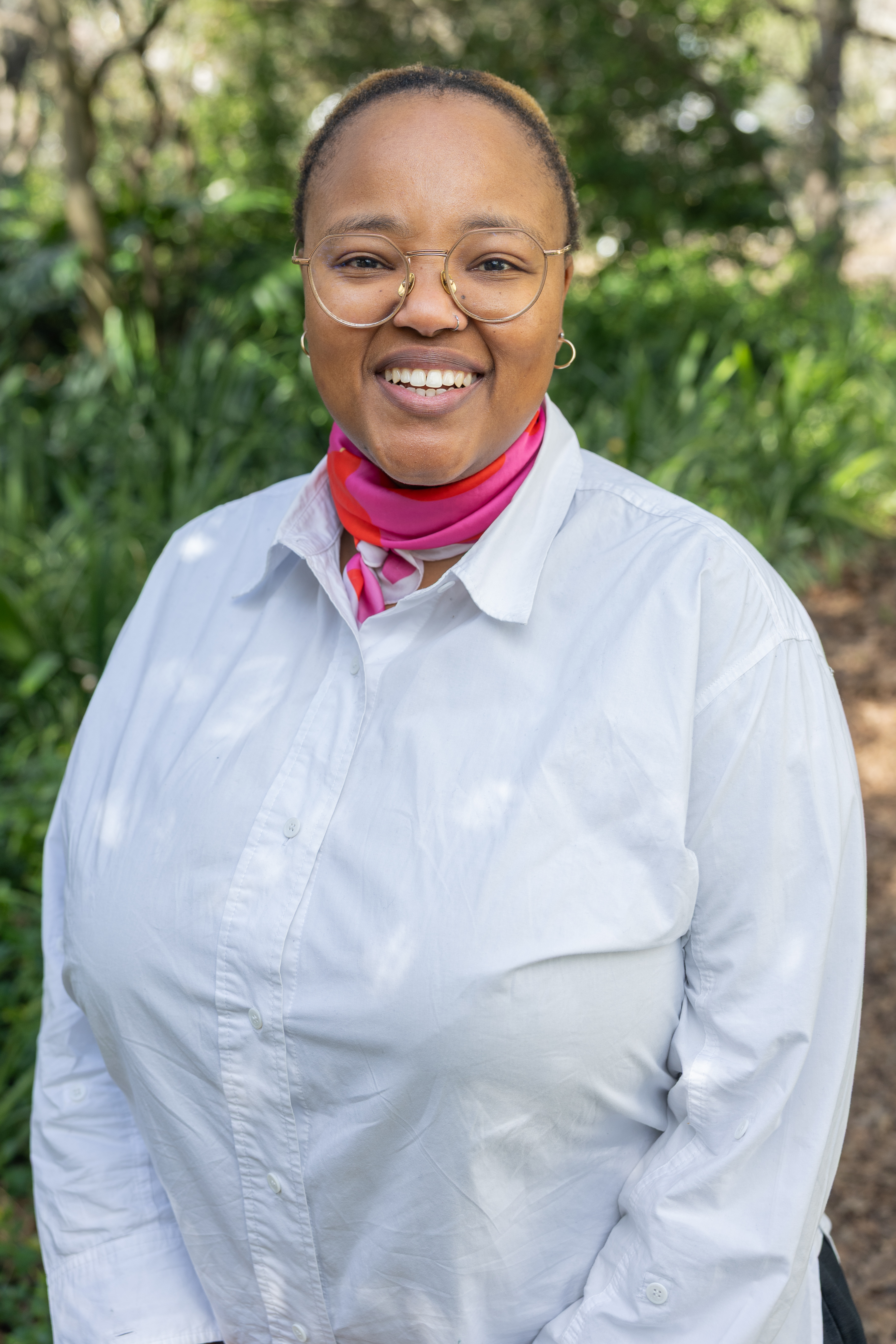
“While discourses about women’s liberation and emancipation dominate the mid to late 20th century, examples from the early 20th century have begun to challenge the ways in which we can historicise women’s theoretical and activist work about women’s liberation on the African continent,” said Athambile Masola of the Department of Historical Studies at the University of Cape Town. “This is part of my feminist exploration of the intellectual legacies of black women’s mobilities – Ukuhamba kukubona – to travel is to see. I’m aiming to see and read black women’s history as a rich intellectual project, not a problem to be solved.”
Masola is part of the eighth cohort of Iso Lomso fellows.
She was described in the introduction by fellow Bridgit Kenny as “a writer who works on other writers. She rebuilds the affective world of black women across generations. She returns our grandmothers to us”.
For her seminar Masola focused on Pumla Ngozwana whom she had first encountered while working on her PhD. “My focus is on one figure, but it comes with links to many women and names.”
“My PhD was a gateway into the world of women back to the 19th century in the Cape Colony and Union of South Africa. Women engaged in writing and printing. A professional class of socially mobile women,” she said. “My family history of teachers, creatives and activists also gave me an introduction to the complex social mobilities these women faced.”
‘A quintessential modern girl’
Pumla Ngozwana was born in 1911 in Mount Frere in the Eastern Cape Province of South Africa. In 1932 she graduated from Fort Hare University with a BA degree and began teaching.
“In 1935 The Bantu World newspaper published an article titled ‘Emancipation of Women’ in the newspaper’s women’s pages,” explained Masola. “It was a reproduction of a speech Ngozwana had delivered at Inanda Seminary, a girl’s school in then Natal. Ngozwana was no stranger to the newspaper world as she was a writer and teacher. She was one of the few women who had graduated from the University of Fort Hare and was a teacher at Lovedale and Adams Colleges.”
“A few years after this speech article, Ngozwana met and married Christopher Kisosonkole and moved to Uganda in 1939 where she was a part of the pre-independence women’s movement as a member of the Uganda Council of Women. In Uganda she became part of the early cohort of African women who joined the Legislative Council in 1956 which was the gateway towards working for international organisations such as the United Nations, UNESCO and the International Council of Women in the 1960s and 70s. As part of an ongoing project (an intellectual biography) this presentation offers a snapshot into Ngozwana’s thinking about the emancipation of women before she moved to Uganda.”
“I believe her writing gives us some understanding of the social history of black women’s lives − particularly the ways thinking shapes, makes and remakes the world which is often out of sync with their desires and dreams,” said Masola.
Masola explained that The Bantu World newspaper (now The Sunday World) at that time presented a cosmopolitan world catering to mission-school educated black people. “It depicted a world of network building, class making, education, culture and racial politics. The women’s pages specifically focused on what a modern woman should be.”
An earlier article by Ngozwana had also been featured in the newspaper under the heading Bantu Women on the Move. “She was a quintessential modern girl,” said Masola.
“For her speech her audience would have been high school girls of similar background to herself. She depicts Inanda as the birthplace of modern Bantu womanhood.”
“It’s about inspiring young girls – with references to the United States and Europe where women are doctors and scientists. It emphasises a sense of being in the world because emancipation includes knowledge about the wider world.”
Masola also explained that the speech acknowledged the tension between the past and present, and the ideal of the new Bantu woman. “Emancipation is about space and labour, and the ability to provide. The need for women to be both excellent housewives and to be working outside the home – showing their modernity and equality to men.”
Masola also emphasised that Ngozwana was aware of her position and that her experience was not homogenous and was able to situate herself in relation to emancipation.
“It’s a call to action for black women,” she said. “Ngozwana uses her own emancipation to offer a genealogy of success and survival.”
Masola summarised some of the developments in Ngozwana’s life after moving to Uganda where she was initially one of very few women in the country with a university degree and her marriage into a family with royal connections gave her the power to get things organised.
“First it was all about getting along, much later it was racial consciousness.”
“Class is an obvious red card,” Masola said in answer to a question. “Ngozwana was unapologetic about using class and family status as mobility. She is actually elite not middle class. Her link to the royal family became stronger with her stepdaughter’s marriage.”
“Her children studied abroad. She had a very interesting cosmopolitan lifestyle and was a particular kind of modern citizen,” she added.
Centring women’s mobility
For her STIAS project Masola intends to move away from the historiography about migration which has centred on the experiences of men as migrant workers or as educated elite who travelled for education and other connections.
“Feminist research has begun to point out the limitation of this narrow focus as it relegates women to the margins. However, black women’s experiences with mobility have emerged through uncaptioned photographs, school records, footnotes and the colonial archive. This project aims to explore the methodological innovations that are possible when reading history through a scattered archive, respond to the gaps in women’s historiography, and further develop a feminist approach in research that centres the experiences and voices of black women’s mobilities.”