
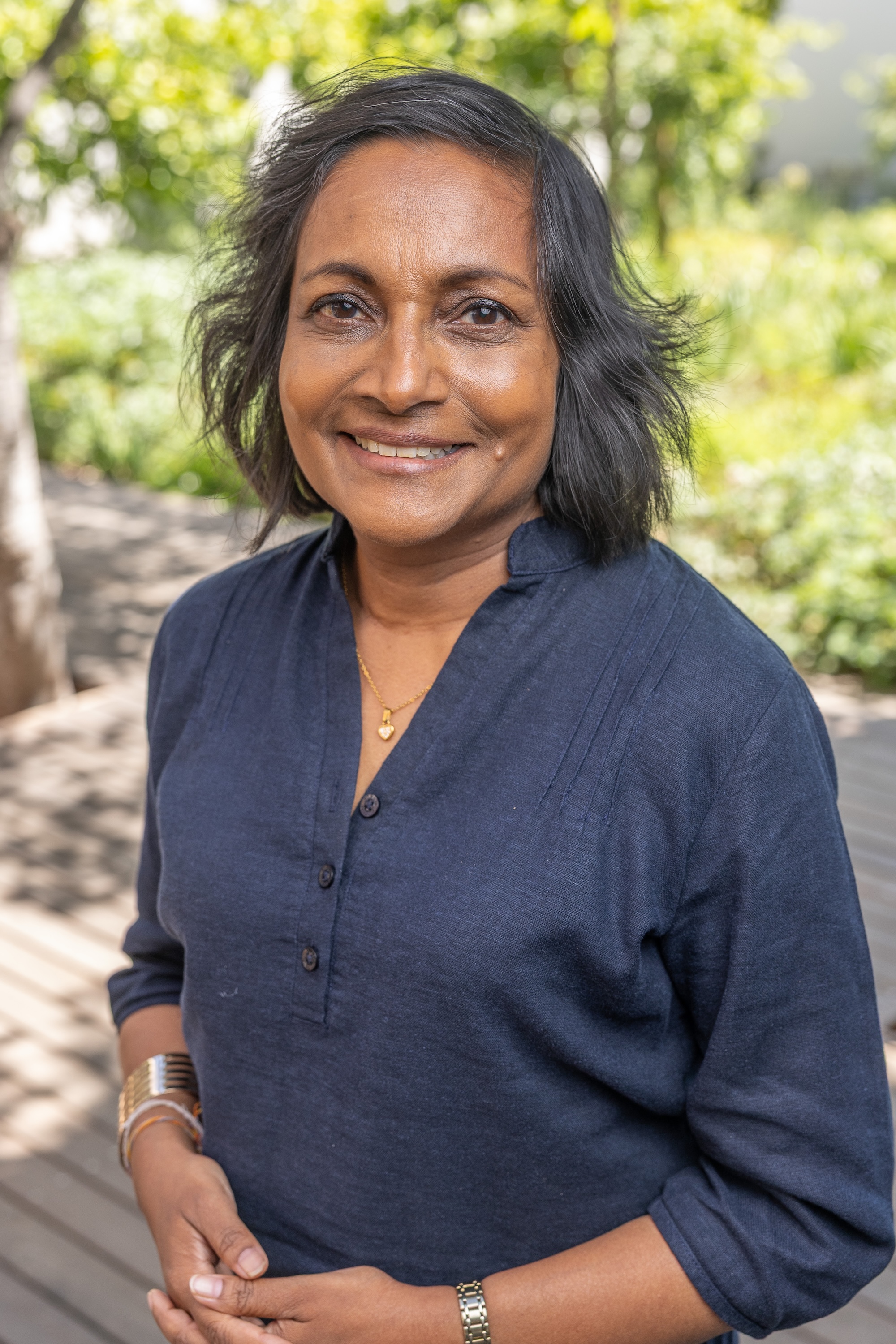
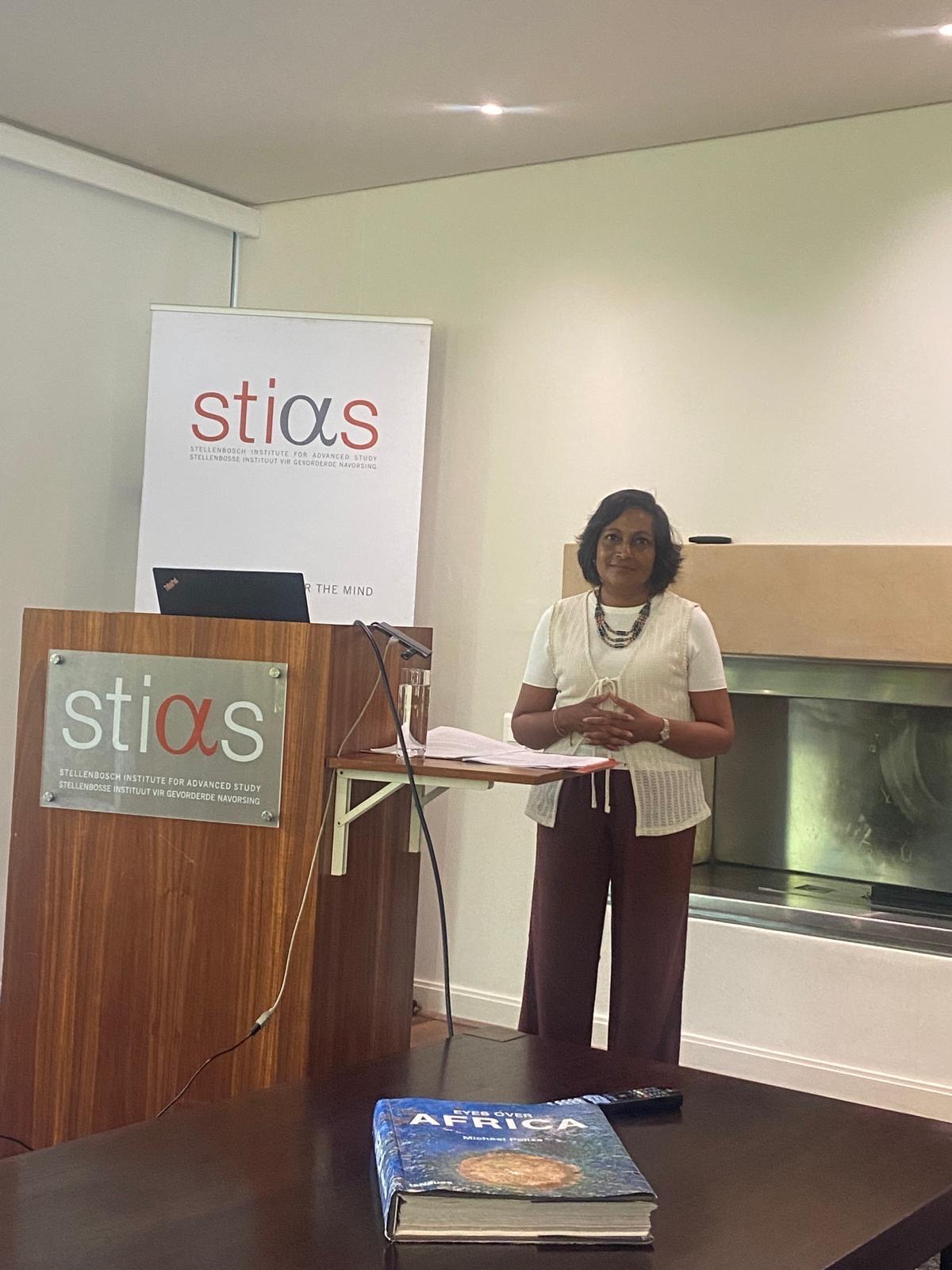
Opening with an emotional reading from an encounter with the father of a victim of enforced disappearance in Sri Lanka, Minoli Salgado set the stage for her central question: “How can literature give voice to the unspeakable — the erased lives, shattered relationships and profound suffering that arise from contexts of exceptional violence such as the Sri Lankan Civil War and the Cambodian Genocide?
Salgado who is from the Department of English at Manchester Metropolitan University and, in addition to academia, is an award-winning novelist and poet, further explained: “Spanning memoir, survivor testimony, autobiography and fiction, witness literature emerges as a vital global archive that engages with and preserves politically contested or marginalised events. Yet it confronts formidable challenges for those academics, human-rights practitioners, journalists and writers who gather and record narratives of trauma. In an era where truth itself faces radical contestation, how can we uphold archival integrity and calls for accountability while fostering morally coherent, victim-centred forms of ethical witnessing?
Drawing on critical and creative practice, as well as foundational concepts in testimony studies, Salgado examined the singularity of testimony, the unreliability of traumatic memory, and the porous boundary between factual record and emotional truth.
She explained that the word ‘witness’ derives from wit which points to mental capacity, while ‘testify’ relates to a third person standing by. “Witnessing is usually seen as something passive while testifying is active. A focus on bearing witness takes us into the way testimonial work has agency. The terms used are slippery. While western terms take us into the difference between witnessing and bearing witness, the idea translates differently in other cultures which can emphasise consciousness and states of mind. In Sanskrit for example. the word used is sakshi – meaning pure awareness.”
Witness literature covers multiple genres including non-fiction, autobiography, survivor testimony, life writing, memoir and fiction. These aim to bear witness to traumatic political and social events some of which may be hidden, contested or marginalised. There are also multiple sites of witnessing ranging from huge events like the Holocaust, the Vietnam War and apartheid South Africa to the more personal like gender-based violence and honour killings. The form may even cover ecocide and environmental crisis. Witness literature is fully global and linked to a common focus on traumatic pasts. It is invariably a personal record of events.
Salgado emphasised that such work can help to further develop human-rights issues, enable reconciliation processes, support democratic representation, serve a juridical role and provide psychological insights to deepen our understanding of trauma and resilience. However, there are aesthetic, ethical and political challenges – including the singularity of accounts, unreliability of testimony, the instability of memory in traumatised, broken subjects and the reliance on emotional or affective truths to provide evidence of an event. She cited Auschwitz survivor, Charlotte Delbo, who wrote, “I am not sure that what I wrote is true. I am certain it is truthful”.
There are critical challenges too, reflected in the wide range of disciplinary approaches to the subject that include the historical, literary and psychoanalytical. “There are different kinds of memory – traumatic, episodic, autobiographical, common and deep memory, Marianne’s Hirsch’s postmemory, which addresses inherited memories across generations, and ‘prosthetic memory’ which is mediated by technology. There are also different kinds of forgetting, such as motivated forgetting and defensive forgetting and different levels of witnessing reflected in the difference between eye-witness testimony and bystander testimony. At heart, though, all witness literature marks an act of displacement – you become a witness to yourself while serving as a witness.
“Witnessing depends on our relationship to the original event,” she added.
In describing what exceptional violence encompasses, she referred to Italian philosopher Giorgio Agamben’s conception of the state of exception where power comes into being through the suspension of the law so such suspension becomes the law – as seen in states of emergency and wars where killing is made lawful; as well as Cameroonian historian Achille Mbembe who described it as the breakdown of legal and ethical boundaries, where the boundaries between resistance and suicide are blurred.
“Right now, we are bearing witnessing to a crisis [in the Middle East] where the very integrity of what it is to be human is called into question,’ she said. She related this to the ghostly voices in witness literature and cited Holocaust survivors Primo Levi ,who wrote that survivors are not true witnesses because the true witnesses are dead and disappeared, and Charlotte Delbo who claimed ‘I’m not alive. I died in Auschwitz but no one knows it’.
“What possibilities of writing the self, of giving voice and reconstructing memory emerge in witness literature?” she asked.
She said that witness literature from the Global South is largely transnational and not only marks the crossing of boundaries between life and death but the boundaries between cultures. ‘I call this mediation across boundaries ‘border witnessing’ and use a second term ‘double agency’ to mark mixed or double affiliations which further reveals the instability of witnessing. If testimony is by definition unreliable, then double agency is a term that allows us to accommodate that instability and the possibility that the witness may be perceived to be shifting positions and even by marked as a double agent. Double agency marks an ethical grey zone that opens the way for us to see how in some cases victims may be perpetrators too. It identifies a space for exploring the voice of victim-perpetrators, or those perceived as such.’
Context matters
“Witness literature marks the role of the imagination in the reconstruction of an event and is a process where moral meaning is made that is context dependent and requires cultural sensitivity and contextual understanding,” Salgado continued. “But it is still read largely in relation to Western critical models of testimony and trauma. To fully understand exceptional violence we need to address non-Western models of trauma, grief, suffering and healing from the Global South where exceptional violence is most prevalent.
“There may be different ideas of wrongdoing and different models of social justice. Readings of what the human and justice means can vary widely.”
She went on to say how in Cambodia there is no word for trauma but instead there are idioms of distress and how in Sri Lanka euphemisms replace any direct reference to conflict. She spoke of her interest in the role of forgiveness and ubuntu in the TRC and the Buddhist concepts of ‘metta’ or loving-kindness and karma in Buddhist Cambodia which inform how justice gets marked and mediated and the different ways in which forgiveness is understood in these contexts.
“I’m interested in producing commonalities while also identifying what doesn’t translate across cultures,” continued Salgado. “More conversations across contexts will allow understanding of commonalities and differences. It is important to identify areas where there are cultural differences for without this it is difficult to build meaningful dialogue and a broad idea of what healing and justice mean in different places. It compels us to reevaluate what might be meant by universal human rights.”
Salgado’s STIAS project specifically explores the aesthetics, ethics and politics of literary witnessing in auto/biographical texts from the S-21 detention centre in Cambodia in relation to the politics of representation and the mediation of victims’ voices in witness literature from the cultural margins. She is interested in comparing these to similar work in other countries including South Africa.
S-21 (Tuol Sleng) was the Khmer Rouge’s infamous security prison in Phnom Penh. An estimated 12,000 to 15,000 people were killed at S-21 and at liberation there were only twelve survivors. At the international tribunal that followed, the Commandant of S-21, Kaing Guek Eav (alias Comrade Duch), took full responsibility and apologised.
“By juxtaposing published memoirs from S-21 with oral testimonies delivered at the Extraordinary Chambers in the Courts of Cambodia, I hope to reveal the limitations of imposing Western frameworks of truth and trauma on a cultural landscape where they often prove marginal or misplaced,” said Salgado.
“Only by attending closely to concepts like Buddhist karma, folk guardian spirits, distinctive idioms of distress, and spiritual practices for soul-calming can we begin to reimagine trauma, personhood, justice and ethical storytelling in the wake of unimaginable violence and dispossession. This exploration invites a deeper, culturally attuned understanding of how testimony bridges personal loss and collective repair, develops both transnational and interpersonal connections and makes the ‘unspeakable’ speak.”
Focusing on one of the survivors, she highlighted discrepancies between memoirs and testimonies; the challenges of dealing with legal procedures and traumatic memory; the role of double agency and ambiguity in constructing truth; the large gaps between legal and cultural ideas of human rights and being human; dealing with personal loss; and, the importance of spiritual healing.
“The experiences of the dead can’t be reclaimed,” she said. “What we have left are remains: the voices of witnesses that are utterly human in their ghostliness and also deeply spiritual. Voices that link self and community and bridge past and present in a way that marks the urgent need for healing and ethical repair.”
In discussion, Salgado discussed the difference between witnessing and bearing witness. “Witnessing is happening all the time but bearing witness – that involves making sense of an event - takes time,” she said. “Distance from an event makes a difference in how witnessing is registered. I’m interested in how we may make moral meaning which can only come after a period of reflection.
She also acknowledged the need to understand silences. “The Sri Lankan War started when I was an undergraduate. I went back and met a range of silences – the silence of censorship, self-censorship, trauma and avoidance. Silence is as important as the voices we hear. We have to receive and retrieve this silence. Bear witness to it.
“We also always need to ask what the storyteller, the witness survivor, wants from telling the story. It’s important to centre that if you are being true to them. Some may want acknowledgement or validation. Others may want accountability or even revenge. This has to be brought out.”
She addressed the different possible ways of writing such stories. “When you write there are different motivations. Fiction takes years – it’s a long process in which you are trying to make sense of something that is still unresolved and give meaning to a constellation of events that mean different things to different people. The novel is beautiful for this. It allows multiple voices and perspectives and can leave meaning suspended so readers have to make sense of things for themselves. A short story distils a moment and the reader is left with one feeling. In a novel the reader should be left with a lot of things to think about.