
Innovations in biological evolution and in human culture – from science to the arts – arise by processes with multiple parallels. One of them is that many innovations originate as ‘sleeping beauties’, creative products that are not successful when they first emerge. They become successful only after a long period of dormancy, and then often dramatically so. I plan to write a book that brings these sleeping beauties to the attention of the general public. The book will cover multiple and diverse examples from all levels of biological organization biology. They range from the evolution of grasses to the emergence of new antibiotic resistance and the origin of new genes. The book will also cover many examples from science and technology, such as the discovery of energy conversation, the development of linear algebra, the invention of the cardiac pacemaker, and the discovery of radar. These examples will illustrate that an innovation’s innate quality may not suffice in ensuring its success in the natural world or in a marketplace. They will highlight the crucial role of the environment for an innovation’s success, including abiotic factors and other organisms for biological innovations, as well as social, political, and cultural factors for cultural innovations. They will also illustrate that innovating successfully is beyond an innovator’s control. Taken together, these examples may also harbor lessons for human innovators who are faced with a lack of success of their own creative products.

Sleeping beauties: Dormant innovations in nature and culture
Related to this project

Publication
Adaptive evolvability through direct selection instead of indirect, second-order selection
Wagner, Andreas. 2022. Adaptive evolvability through direct selection instead of indirect, second‐order selection. Journal of Experimental Zoology Part B: ...

Publication
Environmental complexity is more important than mutation in driving the evolution of latent novel traits in E. coli
Karve, Shraddha and Andreas Wagner. 2022. Environmental complexity is more important than mutation in driving the evolution of latent novel traits in E. co...

Event
Sleeping beauties: Dormant innovations in nature and culture - STIAS webinar by Andreas Wagner
Register here by 11 August 2021 Andreas Wagner professor of the Institute of Evolutionary Biology and Environmental Studies at the University of Zurich, External Professor at the Santa Fe Institute for the study of Complex Systems and STIAS fellow will present a webinar with the title: Sleeping beauties: Dormant innovations in nature and culture Abstract Innovations in biological evolution and in human culture – from science to the arts – arise by processes with multiple parallels.
Article
Sleeping Beauties: Dormant innovations in nature and culture - STIAS webinar by Andreas Wagner
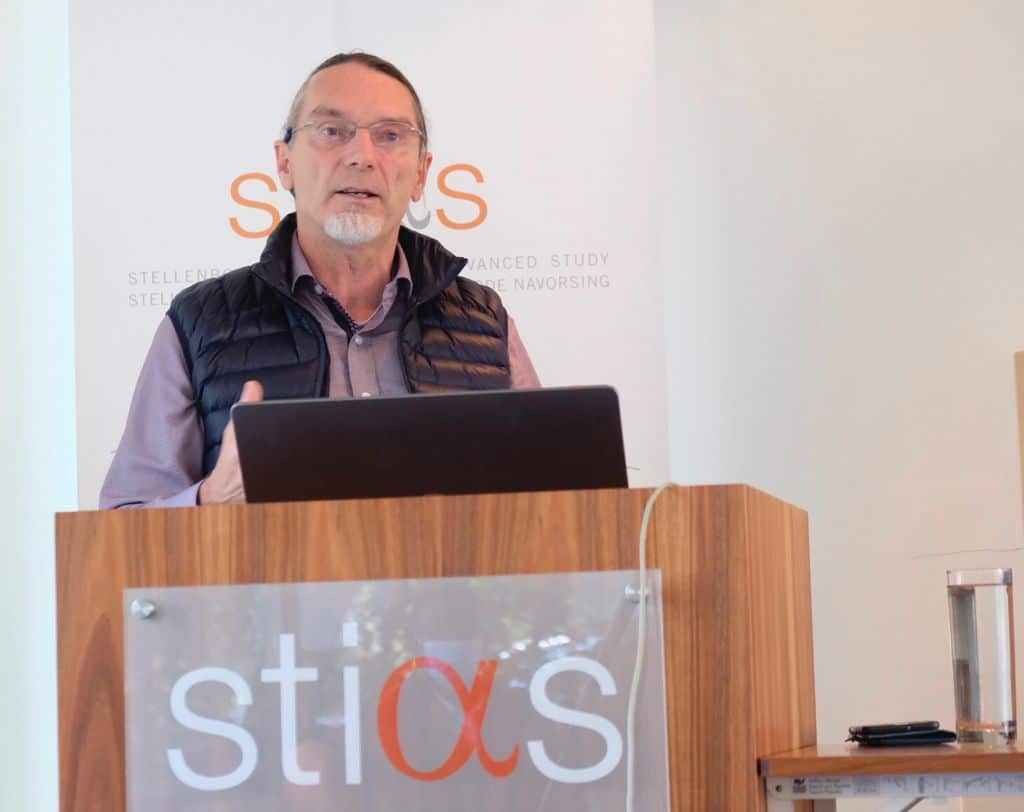
Innovations in biological evolution and in human culture – from science to the arts – arise by processes with multiple parallels, said STIAS fellow Andreas Wagner, professor at the Institute of Evolutionary Biology and Environmental Studies at the University of Zurich and external professor at the Santa Fe Institute.