
It’s a humble piece of cloth used as a wraparound skirt across Africa and Asia with many names − yet its simplicity hides a complex web of historical, social and cultural meanings.
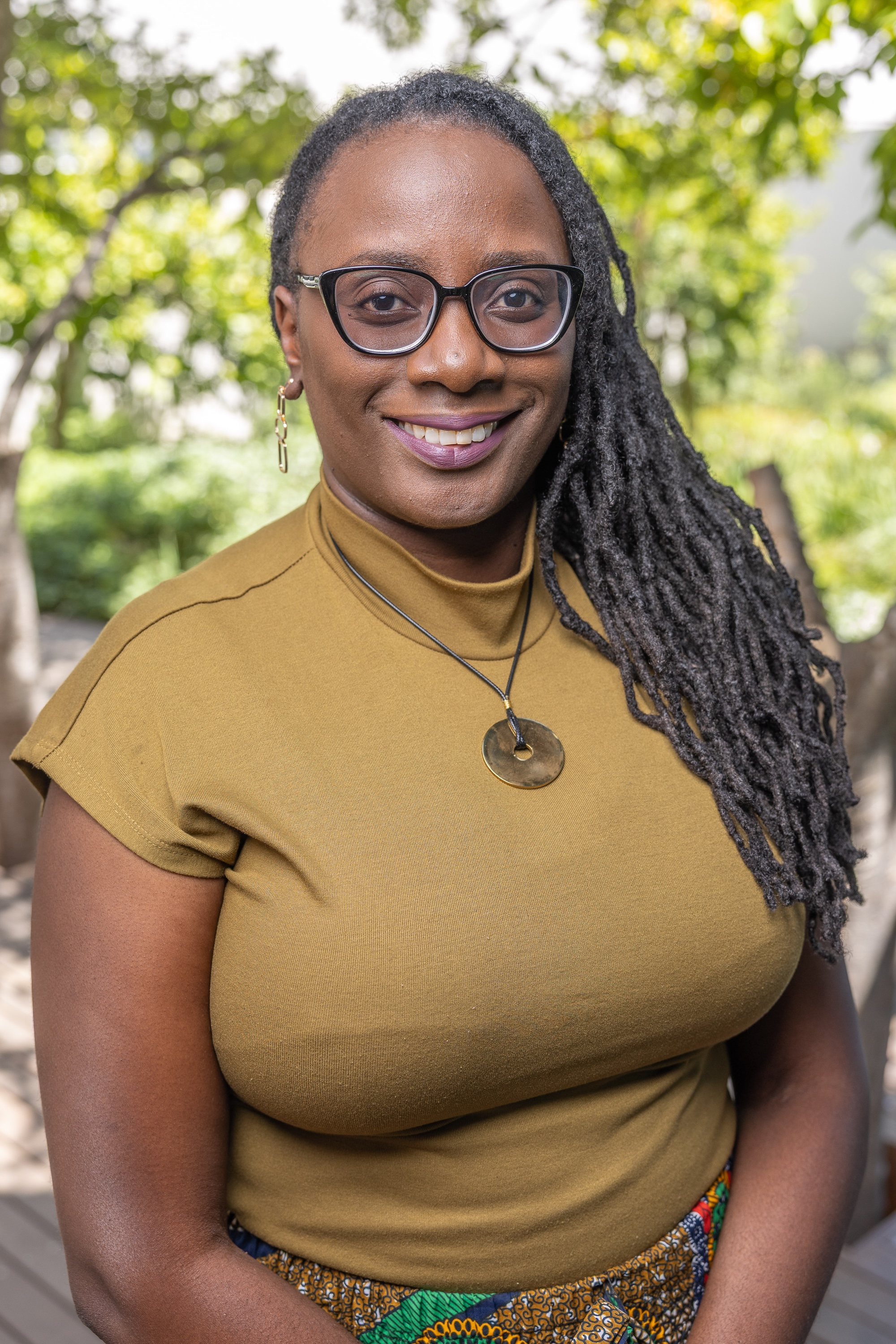
“Historical and political changes have shaped women’s relationship with the chitenje in Malawi. Dress needs to be understood as situational practice,” said Asante Lucy Mtenje of the Department of Literary Studies at the University of Malawi. “Clothing is a mode of inclusion and exclusion, and about the forging of a distinct African identity in Malawi. Cultural exchanges, coalesce and collisions have influenced the commodification of clothing.”
“I’m interested in women’s complex relationship with the chitenje shaped by historical, political and social changes. It has contradictory meanings, that are widely imagined in popular culture.”
Iso Lomso fellow, Mtenje is undertaking a book project examining how the chitenje and its changing meaning has been depicted and enacted in popular culture looking at, among others, cartoons, newspaper columns, art exhibitions and performance, as well as how the chitenje features in women’s social groups and the ideas of femininity created in these spaces.
The chitenje is a piece of cloth, usually 2 metres wide by 1.5 metres long, patterned or un-patterned which varies by the texture and quality of the materials used and is primarily worn as a wraparound skirt. Mtenje explained that it originated when a Dutch company copied Javanese batik cloth from their Indonesian colony and used mechanised dyeing techniques to re-create cheaper versions to sell back to the colony. It didn’t do well and so they looked for another market and found it in West Africa. “It’s ubiquitous in Malawi,” she said. “You see it everywhere. It has wide market appeal. It’s considered conservative, traditional dress by Malawian women.”
“Although the chitenje has been around since the 1950s or even earlier, its construction as a marker of female respectability and sexual propriety and as a form of national dress endowed it with new meanings that remain contested in the present.”
Malawian independence occurred in 1964 at the height of the swinging 60s when long-hair, mini-skirts and bellbottoms began to replace more conservative attire across the Western World.
Attire such as the mini-skirt with its emphasis on the thighs and buttocks became central to the national discourse on moral respectability and nation building in Malawi. “The mini-skirt for women was seen as moral corruption from the West and constructed as foreign immorality,’ said Mtenje. “Women’s bodies became sites through which to articulate fears and anxieties for the future.”
With independence there was a need to create a national culture, exemplified through language and dress, among other aspects by the Kamuzu Banda regime. “There was freedom from colonial bondage and one of the early projects was to ensure people were well dressed. Women were used as an engine of the transformation.”
“The chitenje was encouraged by the regime and seen as the standard for respectable dress for Malawian women. Cultural nationalism was advanced by older men with young women’s bodies as an index of the nation, national order, decency and respect.”
Mtenje explained that until 1994, women in Malawi were prohibited by law from wearing trousers, and mini-skirts. “Legislated in the Decency in Dress Act of 1973 under the autocratic rule of Malawi’s first president, Hastings Kamuzu Banda, these items were considered inimical to Malawian cultural values,” she explained. “Banda’s regime claimed that they salaciously drew attention to a woman’s thighs and buttocks. Those found to be non-compliant were instantly disciplined and subjected to public humiliation or arrested. According to historian, Ruth Mandala, a national committee with the mandate of creating a national dress for women was instituted and a cotton wrapper called chirundu/chitenje to be worn around the waist, accompanied by matching headgear and blouse, was pronounced as national wear for women. To make it acceptable, fashion shows were held and young women made to parade the dress, making their dressed bodies a site for the inscription and performance of the so-called cultural values of the new nation. No national wear was instituted for men.”
“Banda claimed the chirundu/chitenje as African and part of the decolonial project. He saw it as a way of separating the people from colonisation and highlighting nation building.” continued Mtenje. “But he was selective in what constituted Malawian culture – he didn’t consider ethnic differences and practices.”
The state was the absolute authority and state machinery enforced discipline. A tape measure was even used to determine skirt lengths and those who contravened were fined, beaten and publicly shamed. Women would wear chitenje to disguise the fact that they were wearing forbidden clothing.
With the advent of multi-party democracy in 1994 freedom of dressing was enshrined in the constitution but incidences of women being publicly stripped specifically by vendors for their clothing choices still occur.
“However, multi-party democracy made democratic and human rights more visible so women could organise themselves to publicly protest against such violations,” said Mtenje. “In 2012 there were nationwide protests against vendors stripping women of various ages who wore mini-skirts, dresses, shorts and trousers. Women coordinated these protests through various organisations and the female Vice President was also part of the protest marches.”
Mtenje explained that due to this history, Malawian women have a complex relationship with the chitenje. “It still functions both as a site for enforcing women’s domesticity and for affirming female identity, as a medium for performing and contesting national or political affiliation, and as a space that can mute female sexuality whilst also expressing sexual desire.”
Although generally seen as conservative and modest and, as such, worn at traditional engagements, weddings and funerals, it’s also associated with the expression of female sexuality. “It covers the thighs but accentuates the female figure,” explained Mtenje. “In an intimate context it is seen as a non-verbal communication tool for sexual interest. It’s also used in some rural areas to symbolise betrothal. It is given to a woman by the man interested in marrying her which she has to wear as a symbol that she is spoken for. It also indicates the man’s ability to provide.”
She explained that at weddings, designs made from the chitenje fabric may be worn by guests showing solidarity with the bride and in traditional contexts, may be given as a gift enhancing fecundity. Women wear matching garments at social events and partisan chitenjes are used during political campaigns. “Parties spend a lot of money on this,’ she said. “They are given for free to potential members and voters. It brings the party into existence in the everyday. Although it is not only worn by actual supporters – some own chitenjes from different political parties.”
The cloth is also used as a form of archive to store national memories and achievements.
Paradoxically seen as both normalising the domestic as the appropriate place for women, the chitenje is also used to hide the body in public and to cover-up in emergency situations. It’s linked to modes of femininity but also implicated in patriarchal discussions. “There are culturally constructed meanings. It still implies authentic Malawian and the ideal Malawian woman.”
Mtenje will unpack all these meanings as well as forms of resistance by women. One of the cases she is interested in is the Chitenje Changa Monologues – performances adapted from Eve Ensler’s Vagina Monologues which looks at ways the chitenje can open the space for talk about female sexuality. It was first performed in 2015 and performed during the 16 days of activism against gender-based violence. The 2018 edition was initially denied a performance licence by the censorship board but the performance went ahead anyway.
‘I’m also interested in understanding the wearing of the chitenje for fun and pleasure,” she said, “moving away from the binary that Africa is only a place of suffering. I’m interested in spaces where women experience pleasure and how the chitenje facilitates that pleasure.”
“Nakedness and clothing are socially constructed and depend on the time and who has the power to decide who is naked and who is not, what is proper dress and what is not. Dress should be looked at with various lenses including history and power.”