
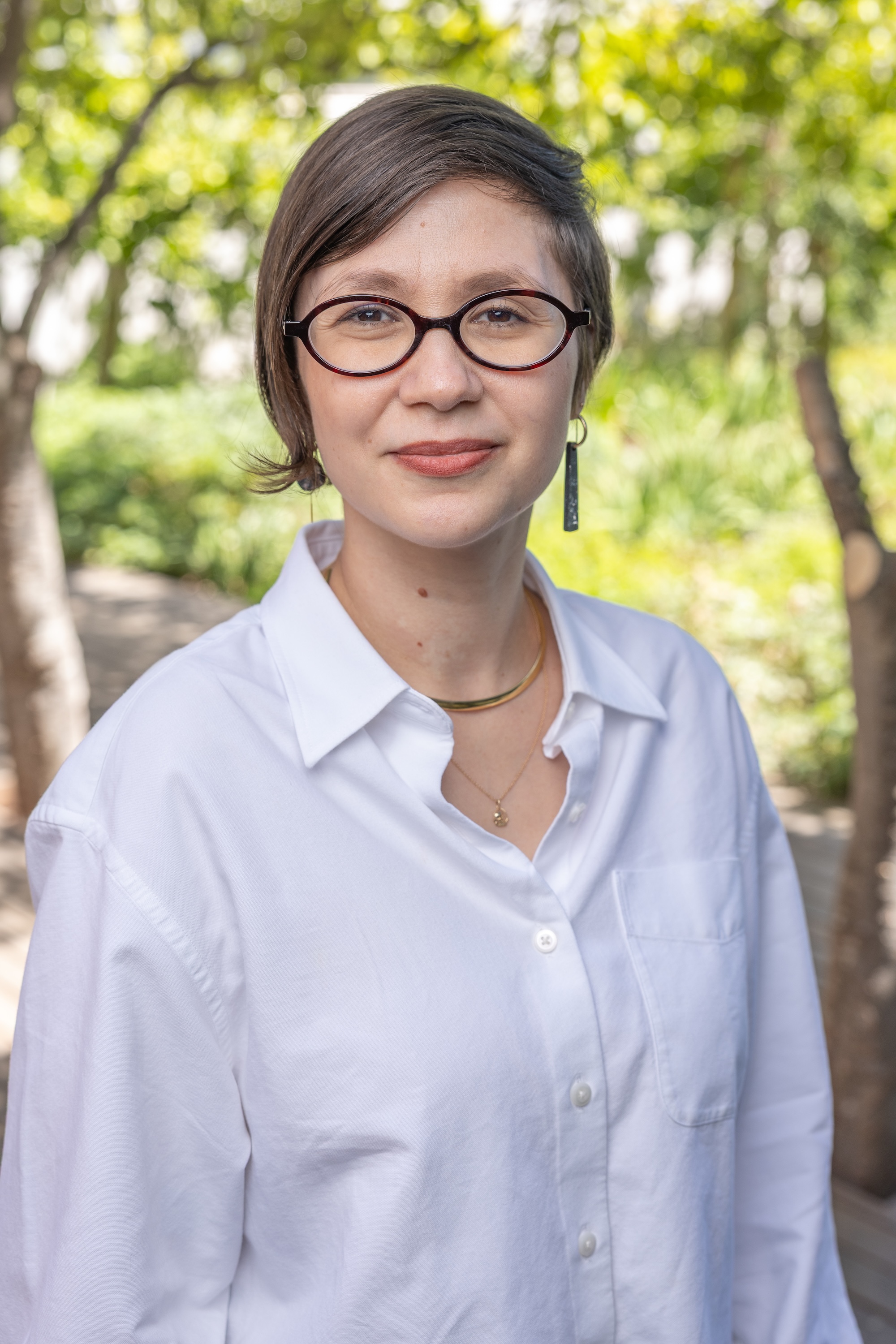
“I propose that tone plus stress results in a tone system that is different from those of the languages that gave rise to the Gulf of Guinea creoles. This system emerged from the loss or displacement of the Portuguese final R leading to a pitch drop as well as the adaptation of part of the lexicon not having a high tone, mainly in nouns of African origin. The emerging system shows a unique interaction of tone, stress and syllable structure with both the African and European origins playing a crucial role in this resulting tonal system,” said Ana Lívia Agostinho of the Department of Vernacular Language and Literature at the Federal University of Santa Catarina in Brazil.
And Agostinho is well qualified to make these proposals as one of the very few linguists working on these languages and someone who has developed pedagogical materials for Lung’Ie.
She explained that there are four genetically related creole languages native to the Gulf of Guinea: Santome, Angolar, Lung’Ie– spoken in São Tomé and Príncipe – and Fa d’Ambô– spoken in Equatorial Guinea.
“Creole languages emerge from the extensive contact (and conflict) between speakers of languages with very distinct grammars,” she said. “These four languages result from the contact between Portuguese, Edoid (languages spoken in southern Nigeria) and Bantu languages. They are linked to the Portuguese violent exploration and the kidnapping and confinement of African populations from the 15th to the 19th century.”
Creole languages are stable, fully developed natural languages that arise from the mixing of two or more languages, often in contexts where speakers of different native languages need to communicate, such as trade or colonisation. They typically blend elements from their source languages and evolve through processes of restructuring, but they are not necessarily simple and can include complex grammatical structures and vocabulary from multiple sources. Like all languages, they reflect the culture and history of the speakers.
São Tomé and Príncipe is an island country in the Gulf of Guinea off the western equatorial coast of Central Africa. The islands were colonised by Portugal in the late 15th century and became a commercial and trade centre for the Atlantic Slave Trade. Currently São Tomé has about 180 000 inhabitants and Príncipe only 10 000. Portuguese has been the official language since the country’s independence in 1975.
Agostinho has been working on creole languages from the Gulf of Guinea for 17 years and collecting data in this region since 2009. “My analysis is based on a corpus of fieldwork data collected by me in São Tomé and Príncipe and in Equatorial Guinea over several years. I am currently conducting a phonetic and phonological analysis of the data using statistical modelling. This ongoing investigation aims to examine the role of language contact in the development of tone systems while also addressing broader questions on phonological typology.”
“Lung’Ie is currently the only one of the four languages taught in the education system,” she explained, “and it is the most endangered. At the time of its introduction in schools in 2009, there were no materials to teach it. It’s an elective subject, and not compulsory. We have been developing materials for teaching and I have conducted training workshops with Lung’Ie teachers.”
In this period Agostinho has also been developing two dictionaries on Lung’Ie and a course book with audiovisual materials for teaching the language. The book is the main teaching material used today in Lung’Ie classes in Príncipe, and it can be accessed online.
“We have been working on one dictionary for ten years. It has about 8000 entries and we hope to finish it in the next year or so. The second is the ‘Lung’Ie Living Dictionary’, available online.”
All in the tone, pitch and stress
Agostinho focused specifically on the emergence of a tone system in these languages, for which the lexicon is about 90% Portuguese and 10% Edoid and Bantu, explaining how sounds are structured in languages to convey meaning.
“A tone language is one in which variations in pitch distinguish different words while a stress language is one in which emphasis or prominence is given to a certain syllable in a word. Stress can also occur on a certain word in a phrase or sentence.”
Tone is common in African and Asian languages.
“The emergence of these Gulf of Guinea creoles involved contact between tone (Edoid and Bantu) and stress (Portuguese) languages, leading to the formation of unique prosodic systems.”
Using audio examples, she explained that “Language sounds consist of consonants, vowels and suprasegments. Most languages have about 22 consonants and five or six vowels. We use different combinations of the same sounds to make words. You change meaning by changing the sounds.”
“Pitch is about high or low wave frequency of sounds. All languages show pitch and changes in pitch also change meaning in sentences, for instance. In tone languages, pitch can change the meaning of a word.”
What she has found in these languages is the impact of the deletion or displacement of the R consonants from Portuguese. “The deletion of the R from Portuguese triggers a tone contrast. ”
Agostinho noted that her results are consistent across the three São Tomé and Principe languages.
“This has been debated for 20 years,” she said. “I would argue that it is a new system highlighting the result of the interaction between European stress and African tone.”
In discussion, she spoke about the lack of data on these languages; the natural changes that occur in languages; the shortage of funding for research; and the challenges in sustaining, revitalising or reclaiming languages.
“Languages do change,” she said, “and younger people who are not first language Lung’Ie speakers don’t do the tones anymore. The pressure of Portuguese is huge.”
“Some argue Lung’Ie shouldn’t be a school subject because you should be able to learn it socially but you can’t if people don’t speak it,” she said. “People say the languages are part of their culture and identity, but they don’t get the opportunity to speak them daily.”
“There is also much debate on creoles. The word itself can have different connotations. However, linguists such as myself have argued that certain features can only be the result of extreme contact situations.”
“I can’t say whether these languages will survive but I want to at least produce the materials so the speakers and their descendants have access to it. There are important links to the culture, traditional medicine, food and nature.”
She would specifically love to produce a recipe book and a book of traditional stories (some of which are also found in Nigeria). “I have the recordings and would love to do a book,” she said. “But it’s hard to do because only a handful of linguists are working on Lung’Ie. I have to do a lot of the work myself because there are no other trained researchers.”
Agostinho believes that linguists have a role to play in helping to revitalise languages. “If you lose a language, you lose the culture, identity and knowledge associated with that language.”