
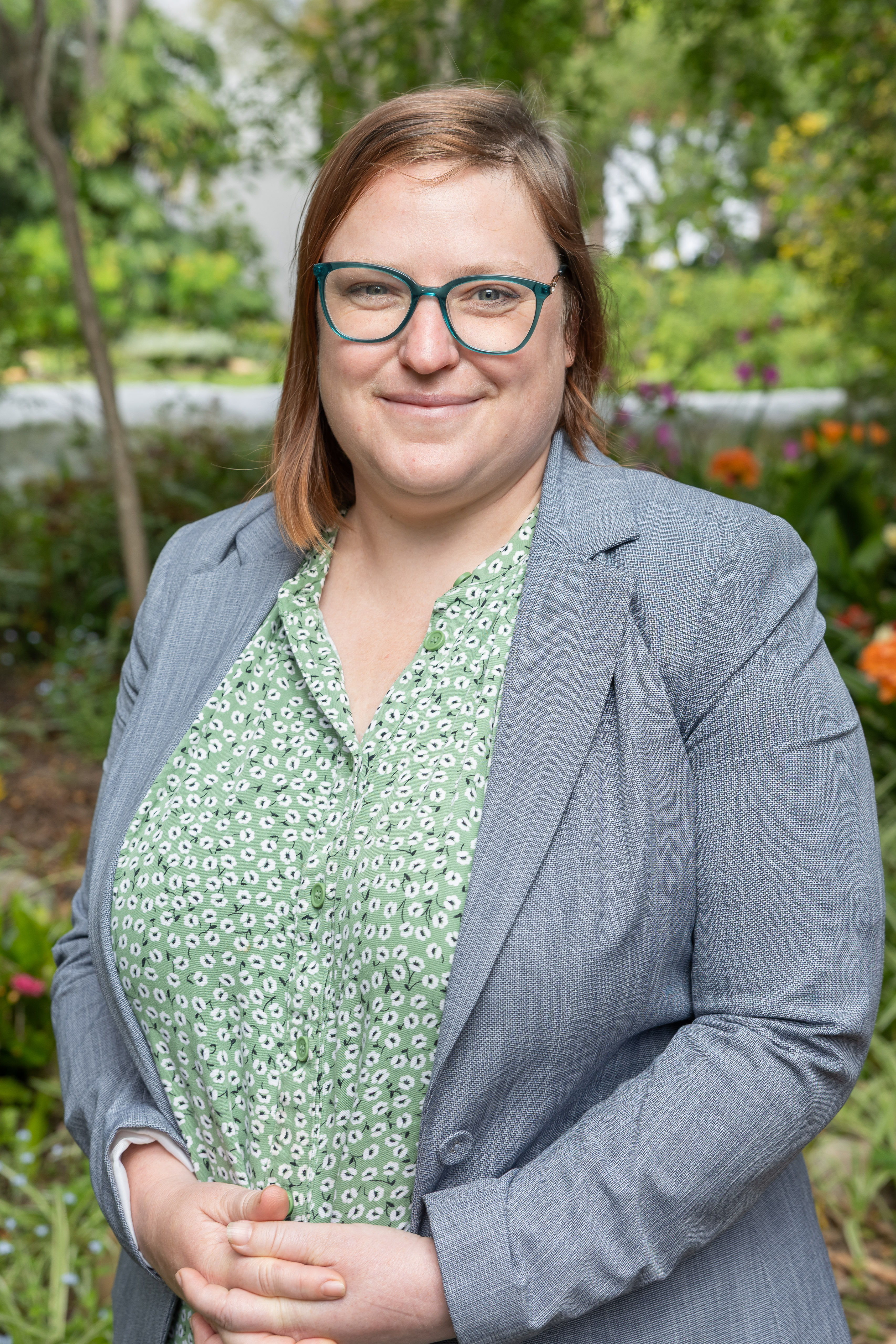
“Historical empathy and different knowledges are important in South Africa where colonialism and apartheid shape current lived realities. Historical thinking is insufficient to capture past and present relationships. We need to engage with historical feeling as valid historical knowledge. For me this has been further affirmed in the STIAS space especially by the quote ‘Being an artist enables you to think with your heart and feel with your thoughts’ by Njabulo Ndebele at the Nobel in Africa opening,” said Iso Lomso fellow Sarah Godsell of the School of Education at the University of the Witwatersrand.
“We have to engage historical feeling as historical knowledge and acknowledge that it doesn’t either weaken or strengthen arguments. We must think about coming from a different angle, disrupting the archive or acknowledging an existing one that’s not being used. We must think about what history means or might mean for young people today and think about what historical feeling offers to history leaners.”
Godsell began her seminar by asking the audience to undertake a free-writing exercise to “put ourselves in a historical feeling space” in which she asked them to think about an historical event and write down what they think and feel about it, how what they know about the event shapes how they feel and how what they feel impacts what they know.
“Affect, feeling and emotion are all fraught terms,” she said. “Emotion is socially and politically embrocated while feeling is deeply race, gender and class embrocated.”
In this she referred to the poem History is the Home Address by Mongane Wally Serote which emphasises that history resides everywhere and we connect with the history residing inside ourselves.
She also explained that her STIAS project is an offshoot of her work in decolonising history education but has personal roots. “It’s about becoming my own affective archive.”
She highlighted several important personal experiences including being taught about the Sharpeville Massacre at school in which the teacher showed the famous photo of bodies on the ground. “I felt that image viscerally – the grief and the complicity,” she explained. “But it was presented as a moment that had been overcome with no present reckoning. I also wasn’t expected to think beyond my feeling as a problem, something to avoid and placate. But I saw that feeling as an entry point, as knowledge and as a resource. I knew history differently from those feelings.”
She also highlighted challenges experienced in her PhD work when she proposed an interaction of cognitive and affect, and the alternate connections that could be made that were non-linear and non-chronological. “My supervisor said I was proposing the end of history.”
“Encountering Sara Ahmed’s work – about history revised and written in different ways helped me to rebound but also imagine and respond to history differently.”
Lastly, she highlighted the impact of the Must Fall Movement in 2015/16 describing it as crucial to her academic shaping. “It was about how history was lived in the present structure and in the curriculum. It highlighted the dualism between reason and affect. Black pain was pitted against irrationality. It made me think about how to support this while remaining honest about my own positioning.”
‘It also emphasised that history feeling is important.”
Historical thinking
Godsell explained that history education has, in the past several decades, moved into a disciplinary approach that attempts to centre critical thinking and analysis rather than rote fact learning. This approach, known as historical thinking, is framed around the idea that historians think in a specific way and use a specific set of historical-thinking skills namely historical significance, evidence and interpretation, continuity and change, cause and consequence, historical perspectives and ethical dimensions.
This approach has been important in putting the focus on analysis and evidence rather than learning dates and facts, but comes with limitations and has faced critique.
“Historical thinking has been influential mainly in the Anglophone world but is still seen as coming from a settler-colonial perspective which determines what history is and how it should be approached. It’s been critiqued by Samantha Cutrara for putting a ‘settler grammar’ on history education and shutting out other ways of approaching knowing and learning history, particularly indigenous approaches,” said Godsell.
“Another result of this strongly cognitive approach is that it has entrenched a dualism in history education between thinking and feeling, with emotion in class often approached as an obstacle, or something to be managed and contained.”
In this regard she noted debates about the work of Sam Wineburg author of Historical Thinking – (“a seminal text that emphasises the need to disengage from what we know and feel to engage with the past on its own terms”) and Howard Zimm author of A People’s History of the United States.
Evolution of history teaching in South Africa
Godsell also explained aspects of the evolution of history teaching in South Africa and highlighted some of the challenges. “There have been three curriculum changes since 1994,” she said. “Before that it was an exclusive tool of apartheid propaganda. But world history as included is still Global North in orientation. It’s also very content heavy which makes it hard to fit in critical-thinking skills. There is a lack of indigenous, as well as female and queer inputs. The lens remains colonial.”
She also emphasised that the realities of South African classrooms – where there can be as many as 80 or 90 learners, no equipment and no electricity – makes the study of history particularly challenging.
She explained that following a Ministerial Task Team in 2015, the 2018 report proposed a new curriculum that included work from other disciplines and viewpoints “but the political work and resources to implement are not there”.
Feeling not just thinking
Godsell’s project is trying to think (and feel) through another approach to history education − historical feeling rather than historical thinking.
“Although this approach risks further deepening the duality between thinking and feeling in history education, I use this position to think through affective knowledge (and feeling more broadly) as historical knowledge, and where and how that can be used in a practical sense in South African history classrooms. This is rooted in my work in history education from a teacher education perspective, examining practical potentials for decolonising history education classrooms.”
“But what does it mean to feel and also think historically?” she asked. “And what will it look like practically in a history class?”
She emphasised that the teaching history in this way brings up questions of neutrality and dealing with feelings in the classroom. “It’s strongly debated and often gendered. It’s argued that it dilutes clear thinking, leads to bias and is uncontrolled and dangerous. There are also questions about what we do with emotions once we have let them in.”
“Regarding neutrality, we know that realities are more nuanced,” she said. “And that neutrality often hides an ideological position – as we are seeing now in the genocide in Palestine.”
“Knowledge is fluid and dynamic, always moving and evolving,” she continued. “Taking affective historical knowledge seriously can deepen relationships between the past and present. Also feeling is present even if not acknowledged. Feeling and thinking don’t override or cancel but enhance each other.”
“We are asking how to decolonise history when it’s already happening,” she added. “In South Africa there is little control of the curriculum, so we are teaching in the decolonisation cracks as Catherine Walsh has described. Much has to be done in the cracks which exist as a resource in a resource-scarce environment.”
She indicated that building feeling into history pedagogy and assessment involves bringing in pedagogies that facilitate creativity, listening, openness to othered and silenced histories, and recognising students as holders of the own histories and builders of their own narratives. “For example, South African students are bored with studying apartheid because it’s not taught from any emotional, connected point. We have to tell students they have histories even if they haven’t studied them. Emotion holds all of this.”
She believes we can do history in interesting, creative and beautiful ways.
“There is a danger in dealing with emotions in the classroom, but it’s not so dangerous that we shouldn’t go there. We must find how to work with it in ways that don’t shut it down.”