
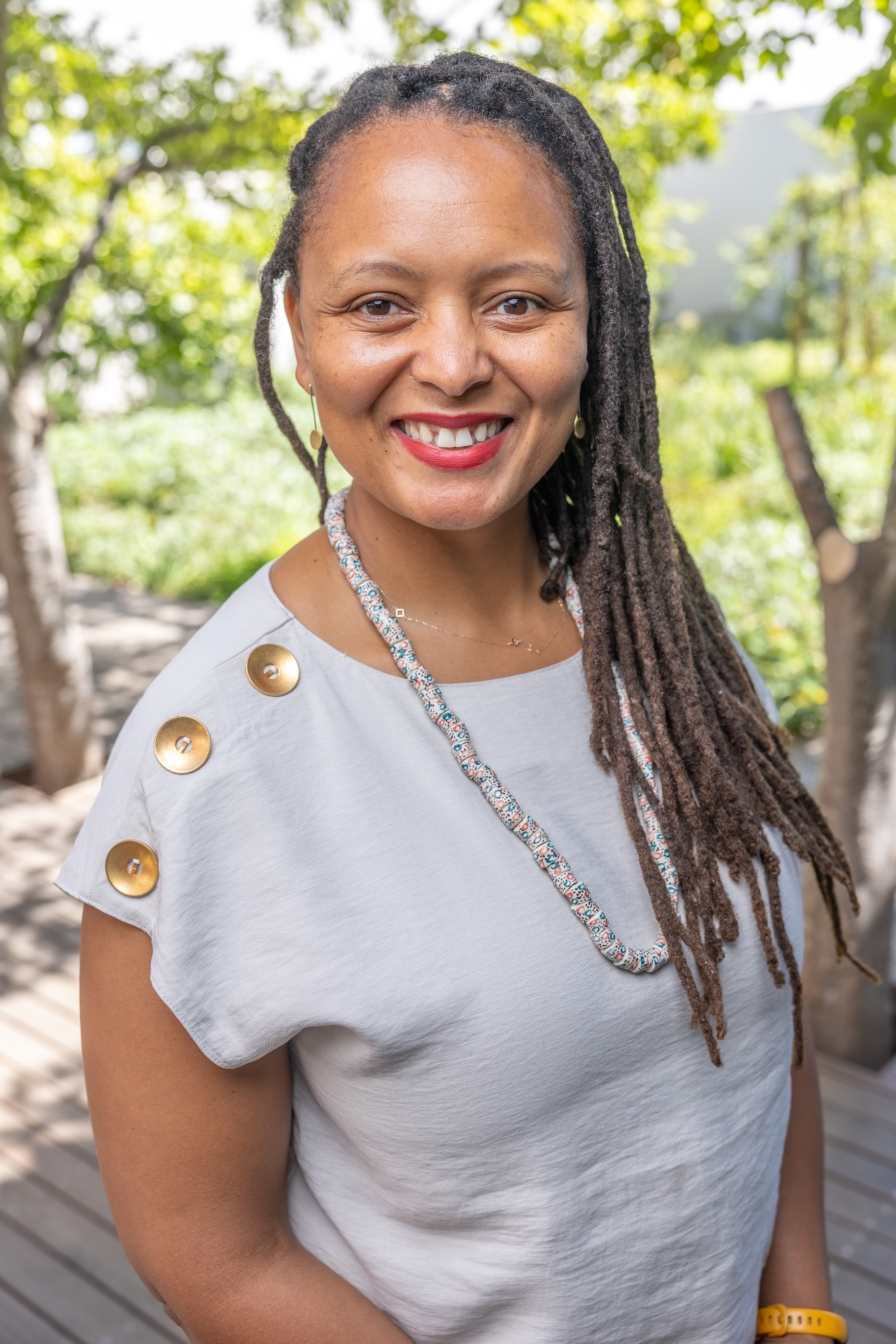
“Extractivism is not a mode of production that starts at the mine gate and ends with resources in the North. It enters homes, kitchens, wombs, rivers, lungs and ‘futures’,” said Asanda Benya of the Department of Sociology at the University of Cape Town.
“The losses are deeper than just the plunder of resources from the Global South to the Global North. Lives and identities are being reconfigured. And the high cost of extractivism is being carried in disproportionately gendered ways. This shapes both current lives and futures. It’s not just about land being lost – life is being snuffed out and women are the shock absorbers.”
In her fascinating and passionate seminar presentation, Iso Lomso fellow Benya expanded on her earlier research into women in mining which saw her spend a year working underground to understand the conditions and challenges experienced by women in this space “I wanted to understand gender subjectivity in a world that valorises masculinity and risk taking,” she explained. “I’m now attempting to zoom out into new mining frontiers while still aiming to provide a feminist intervention to the literature on mining − placing women as the central actors.”
She dedicated the presentation to her grandmother who passed very recently and to mama Fikile Ntshangase who was gunned down in her home at Ophondweni, near Mtubatuba, on 22 October 2020 for opposing mining in her community.
“Industrial mining in South Africa is not only an economic activity but a historically and socially constituted system of accumulation that has shaped social relations for over 150 years. Emerging from the late 19th-century mining revolution following the discoveries of diamonds in Kimberley and gold in the Witwatersrand, mining was central to South Africa’s transition to racialised capitalism,” she explained. “As a mode of extractive production, it reordered life and livelihoods, entrenching hierarchies of race, class and gender across the southern African region. The sector’s contemporary significance, with over 13 million people directly and indirectly dependent on mining for their livelihoods, reflects the durability of these extractive political economies.”
“Drawing on extractivism and ecofeminist literature that conceptualises mining as a predatory system, I hope to demonstrate how environmental, social and economic costs are displaced onto women and other marginalised populations,” she continued. “These costs, I argue, are unevenly distributed along racialised and gendered lines. By foregrounding women’s lived experiences, I aim to demonstrate how extractive capitalism externalises its recurrent crises.”
“My goal is to uncover all the ways in which lives and livelihoods are touched by mining and extractivism.”
She also noted that her data is new and not fully analysed. “Sociologists have to build relationships,” with people and communities they work in, and not come to extract data and leave, “so the work takes time.”
Benya is looking at both the traditional mining provinces of South Africa - the North West, Free State and Gauteng, and also Northern KwaZulu-Natal and the Eastern Cape which have always been labour-sending provinces but in which there is now also a lot of prospecting. One of the sites where she conducted field work in KwaZulu-Natal “there is an anthracite coal mine,” she said. Anthracite “is, supposedly, high-quality coal, and therefore demand is high. It is also a known carcinogen”
“There has been a huge increase in prospecting across the Global South,” she said. “There are no reliable figures for South Africa, but the numbers are believed to be very high. Estimates from various industry data sources indicate that there are over 6000 licences have been awarded in South Africa for prospecting in minerals in the last six or seven years. This has major implications for lives and livelihoods.”
She explained also that traditionally mines in South Africa were in white towns like Johannesburg and Welkom and black men left their homes to work in them. In the post-apartheid period there has been a shift to areas formerly designated black and this shift has contributed to land dispossession that includes “expelling both the living and dead”.
“The state is actively facilitating this dispossession,” she added. “The state is colluding with capital to continue forced removals and restrict rights. It is cannibalistic neo extractivism.” (Here she credited the work of Marxist feminist theorist Nancy Fraser on Cannibal Capitalism.)
Benya highlighted some of the emerging themes from her data including the lack of open consultation, dispossession and displacement, forced removals, lack of fair and full compensation, environmental harms and exploitation of bodies.
“Understanding who is consulted, who is dispossessed and how is vital,” she said. “Women in households may not even be informed, and in women-headed households specifically they don’t even know until people are digging on their land. It’s not gender neutral; women are systematically excluded even though their lives are most affected. Consultation also shapes how land is later allocated, if it is. Women are often not fairly compensated and are often resettled in distant and arid areas. This produces gendered forms of inequities.”
She highlighted many similar stories from her interviews − some of the women have been forcibly removed two or three times in their lives; they are not given the option of rebuilding; and, if they are allowed to rebuild, not given the opportunity to have opinions on the size, structure and style of their houses. Resettlement also doesn’t consider things like access to water and community networks.
There is also destruction of graves and sacred sites, and common grazing lands “in other words, the commons are also affected and disappearing”.
“The law is ambiguous on fair compensation – when people receive compensation it’s often not fair. There are no global or culturally appropriate standards on what constitutes fair compensation. As a result, there is an undervaluing of lives, belongings and properties,” said Benya.
“People also don’t just want compensation, they also want the right to refuse mining.”
“There are many reports of intimidation. Lots of the activist movements are led by women. Hit men are everywhere carrying AK47s and organised to kill activists, demolish structures and poison livestock.”
Benya also pointed to the environmental and health impacts particularly with open-cast coal mining leading to deadly dust that contaminates vegetation, water, food, and animal and human health.
“This is snuffing the life out of the future generations, and who are the caretakers? The women.”
“Such predatory extractivism leads to dim, dark futures for the Global South,” she concluded.