
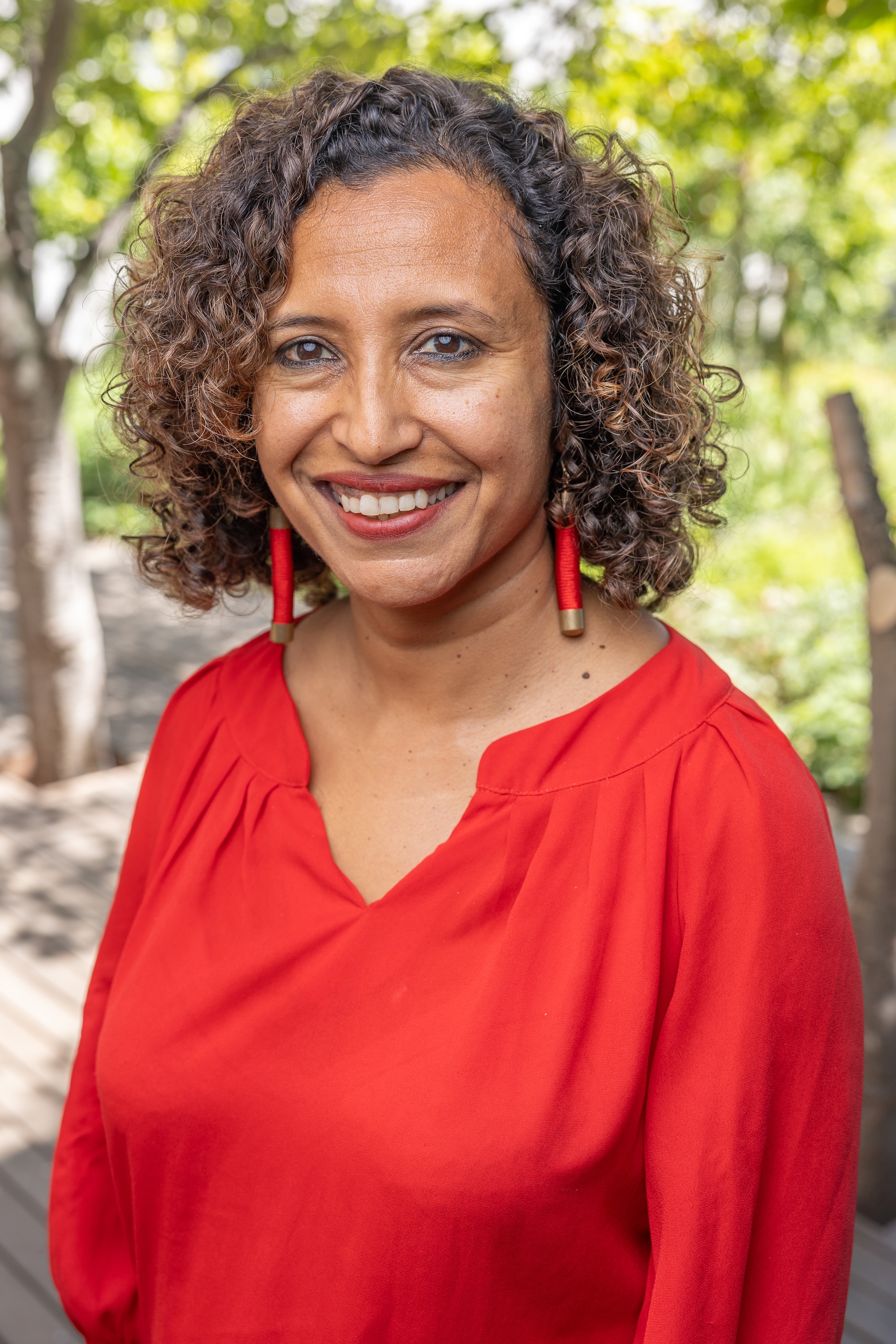
“Conception is no longer one man, one woman and sex. Wealthy parents travel for a genetically related or tailormade baby. The industry is divided into segments, each with their own markets. Now these have taken a southern turn,” said Amrita Pande of the Department of Sociology at the University of Cape Town.
Pande provided an overview of her forthcoming book, Desire-Design-Delete: Global Fertility Industry and the Future of Humanity which is currently in the review stage. The book traces the flows of reproductive labour and technologies across countries in Asia (India, Cambodia, Nepal) and Africa (Ghana, South Africa), mapping how global fertility markets produce, distribute and constrain human life.
Pande’s research, conducted between 2012 and 2023, has included travelling to Cambodia with 21 travelling egg providers; interviews with 29 intended parents from Bangladesh, Cambodia, Canada, China, Germany, India, Israel, Sweden, the UK and US; interviews with 15 medical professions in Cambodia, Ghana, Nepal, Thailand and India and with 31 gestational mothers in Cambodia, Ghana, India and Nepal.
“Drawing on what I call ‘itinerant ethnography’ I follow the journeys of egg providers, gestational mothers and intended parents across multiple clinics and countries, uncovering how desires for genetic relatedness, health and selective reproduction are shaped by intersecting inequalities, postcolonial legacies, and the political economies of global fertility.”
She described an industry dominated by a small number of service providers including fertility specialists, brokers and, even, couriers. Each segment equals one service provider. “For example, it might be ‘white’ eggs from South Africa, an embryo from India and a womb in Cambodia or Ghana. Then the baby goes back with parents to Europe, North America, Canada, China, etc.”
“It’s a mistake to think of surrogacy only as a story of reproduction,” she added.
And at the heart are young women who are either egg donors or gestational carriers (surrogates).
“Gestational mothers often have restricted choices with very little income for survival. They participate in a difficult, dirty industry – some are forced or it’s negotiated with their families,” said Pande. “My forthcoming book picks up where I wrapped up my first monograph Wombs in Labour for which I conducted an immersed ethnography of a gestational surrogacy clinic and hostel in India and interviewed 113 women. These women survived exceptionally hard labour but felt valued because they had produced something of value. Often their fertile bodies are taken care of for the first time – they previously couldn’t afford healthcare services but now it’s best care for the eventual parents.”
“We need to pay attention to the stratifications that centre lived experiences,” she added.
She also explained that legislation has not stopped the business. Since 2016 the industry has been pushed out of countries due to changes in national laws regarding surrogacy but “legislation only shapes it doesn’t stop”. She has traced the domino effect as the bans float the business from country to country.
“Prohibition does not end commercial surrogacy, it displaces it,” she said. “Bans in the Global North externalise demand and risk to less-regulated markets. Restrictive frameworks often increase, not decrease ethical and humanitarian risk.”
Currently India and South Africa have emerged as leaders in this enterprise due to the presence of good, English-speaking doctors, access to technology and luxury private hospitals.
‘White’ egg donors
Pande focused on so-called ‘South African egg safaris’ and the travelling egg providers – young white, predominantly Afrikaans-speaking girls who travel the world donating their eggs.
South Africa is the cheapest white egg provider at about US $2000 dollars a cycle.
She described the donors she has met as “young Afrikaans girls who want to escape the farms and get a glimpse of a cosmopolitan life. It’s a passport to see the world and visit exotic locations, and seen as a way to escape rural, conservative families. They insist it isn’t about the money, but for the adventure, to escape their class status and to have more control of their lifestyle”.
“Egg selling can be a painful procedure that can lead to later infertility – but this is not shared in detail. And they may not be able to receive help for side-effects because they can’t report them.”
And why is there a demand for ‘white’ eggs?
Pande explained that the clients are often also white and want to pass off the children as their own. They describe wanting to feel a deeper sense of parentage and compensation for the loss of a genetic match. “They talk of a need for closeness to establish a spiritual connection with the child. I’m not vilifying the choices, but they often use race as a proxy for all shared affinities.”
Pande also indicated that Asians are a growing clientele who ask for white eggs because they want mixed-race babies with Asian features but blue eyes and white skin. “One in three asks for white eggs. They want tailormade, perfect babies – especially if it’s the second baby. Racial hybridity is seen as a marker of coolness and desirable otherness.”
She also mentioned the desire for gender balancing and the existence of packaged deals like a guaranteed son or daughter package – “although it’s usually a son”.
“These shifting notions are important to understand,” she added. “It’s a nexus of science, capitalism and conscious choice. Black mixed-race children in Asia are seen as undesirable and can face intense marginalisation. What is desired and purchased will allow the next generation to receive economic privileges. Individual desires are therefore shaped by post-colonial ideas of race-based aesthetics and proximity to whiteness.”
From perfectibility to deletability
Pande concluded by focusing on a future of advancing reproductive genetic technologies where not only undesirable traits can be screened out but where we can determine “who exists and who can be pre-emptively deleted. Not who dies but who is allowed to be born”.
She explained her ‘3Ds’ – Desire, Design and Deletability − to show how parental and societal desires intersect with emerging reproductive technologies to produce futures where certain bodies are prioritised while others are rendered disposable or gradually erased. “By centring gender with caste, race, and debility, and by incorporating ‘minority imaginations’ from the Global South, I reframe debates about reproductive labour, reproductive justice, perfectibility and the ethics of intervention in human life.”
“As assisted reproductive technologies become tools through which families invest in children across borders, parental preferences cannot be dismissed as private or innocuous choices. In the global fertility industry, the demand for particular traits in egg providers and gestational mothers actively reproduces caste-based, racialised hierarchies with consequences for reproductive and disability justice.”
“Why are we investing so heavily in these technologies?” she asked. “The rationale is that they prevent inherited disease and disability. But it’s a deeply normative understanding of health and disability. Disability justice would lead to a different perspective.”
“These are technologies that pre-empt decisions about who is not worth bringing into this world. If we have such preconditions for birth what happens to humanity?”
“As academics we must expand the debates to include social, epistemological and intergenerational risk,” she said. “We must insist on a place at the table. What is being created for your future is your business.”