
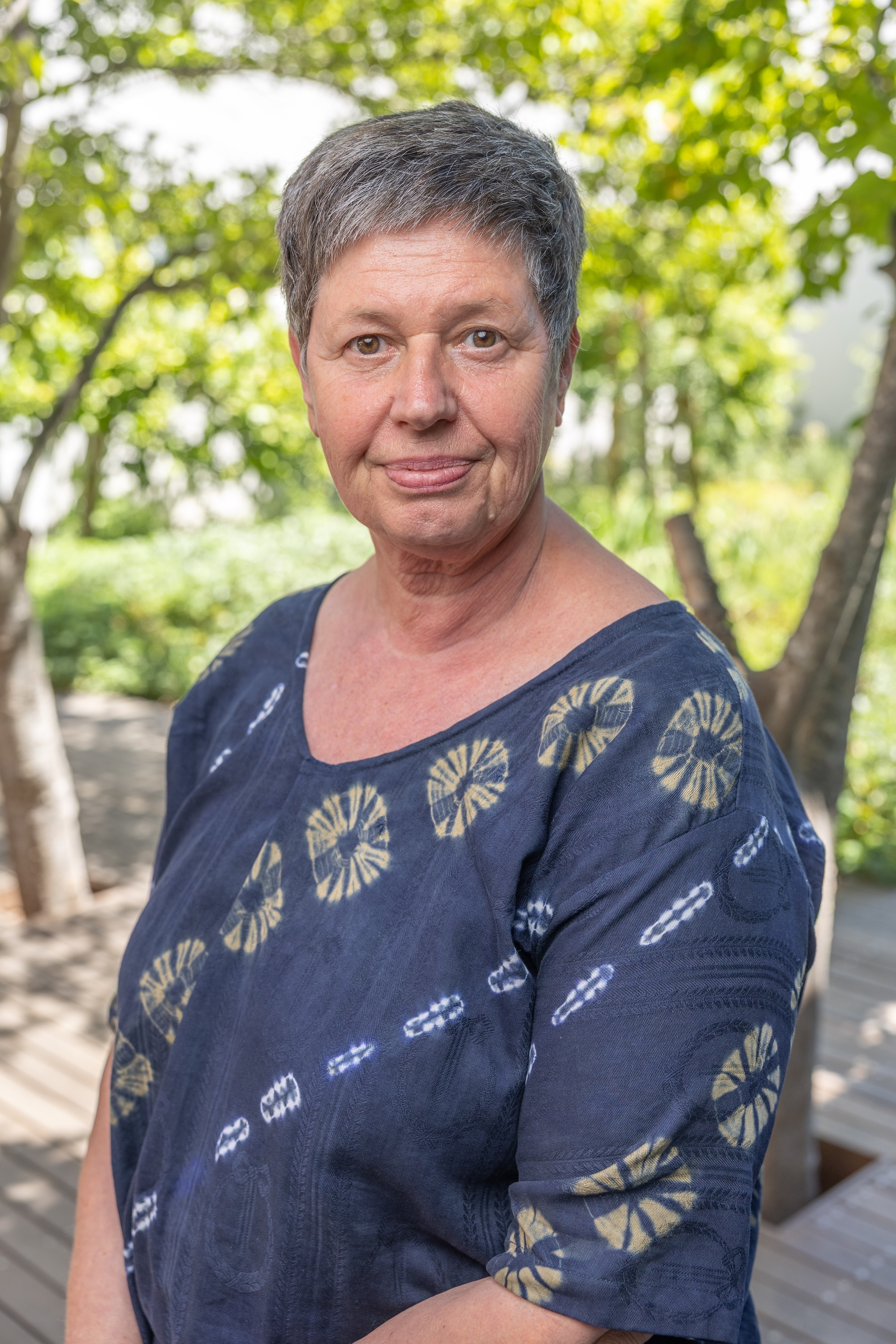
“In family law systems worldwide, there is a movement from determining familial rights on the basis of statuses like marriage, parenthood and so on, to allowing parties to determine their rights through legally enforceable agreements or contracts,” said Elsje Bonthuys of the School of Law at the University of the Witwatersrand. “My book project at STIAS concerns the legal treatment of contracts within the realm of family law – what contracts can do, what they can’t do and, specifically, the extent to which they can be used to alleviate or reinforce the many structural power disparities between family members and different family forms.”
In this presentation Bonthuys specifically focused on the use of contracts in customary marriages between South Africans in three contexts – lobolo agreements, polygynous customary marriages and simultaneous civil and customary marriages.
“Family law is the repository of a lot of inequality in our society,” she said. “Only some of which has been resolved. This inequality is largely based on gender and race. I’m investigating whether contracts can resolve inequality or make it worse.”
She started by explaining the tension between status and contract in many areas of law. Legal status depends on membership of a specific category of people, like husband, wife, or dependent child and the law then assigns legal rights and duties on the basis of a person’s membership of this particular group. This has the advantage that legal rights and duties are easily established once status is determined, but the disadvantage is that legal rights and duties based on status often reflect a patriarchal or racist view of families. For example, in the not-too-distant past, a wife automatically fell under her husband’s ’marital power’, merely as a result of being a wife, unless she specifically excluded this consequence of marriage by an antenuptial contract.
By comparison, a contract is an agreement between two or more parties and legally enforceable in court. “A contract is distinguished from a mere social arrangement because the parties have an intention that it should be enforced by the courts,” she said. “The benefit of basing rights on contract is that it reflects the wishes of the spouses, but legal thinking around contracts tends to assume that both contracting parties are economically and socially equal, and ignores structural inequalities which are pervasive in families. Furthermore, a person who wishes to claim rights on the basis of contract must prove the existence of the contract to a court – a process which may be financially out of reach of most South Africans.”
In context
Bonthuys also described the South African socio-economic contexts, specifically pertaining to racial and gender inequality. Presenting poverty statistics from 2006 to 2023 she explained that these remain organised in apartheid racial categories which reflected deep inequalities based on race and gender. “Since democracy absolute poverty levels across all groups have reduced but black African people remain 93.6% of the poor in 2023. This is what apartheid intended to do, and its lingering structural effects continue to do.”
“Customary marriages are concluded between members of the most disadvantaged group, with African women, especially those who live in rural areas, being at an economic disadvantage vis-à-vis men in these marriages.”
“Similarly for gender, women are consistently poorer than men. Absolute poverty has reduced across all groups, but the racial and gender differences remain constant. Structures of race and gender interact – what is called intersectionality – so that white and Indian women, although poorer than men in the same racial categories, are still much wealthier than black or coloured men.”
As in other countries, “Marriage is declining, divorce is increasing and the fertility rate is declining,” she added.
She also explained the different types of relationships/marriages currently in South Africa, ranging from unmarried intimate partners which she described as the most vulnerable group and with the most limited rights especially for women; civil marriage which is the most privileged, has enjoyed the longest legal recognition and strongest automatic rights; customary marriage which is now recognised and aims to provide equal rights to wives; and, civil unions which are the result of litigation by the gay and lesbian community and have the same rights and duties as civil marriage. The latest category of marriages to receive full legal recognition are, Muslim marriages. Legal rules for these marriages are currently being developed as result of a 2023 court case and proposed revisions to the marriage legislation.
She then described the three main matrimonial property regimes which determine how property is owned and divided during and after marriage. The default is community of property which means there is one joint estate, divided in half at the end of the marriage. “This is generally beneficial for women who fulfil a more traditional homemaker role,” said Bonthuys, “although debt – even premarital debts – are also shared.”
Marriage out of community of property with accrual means that during the marriage, spouses have separate estates. However, at divorce or death the growth in both estates is shared equally with no shared debt. “Wives in traditional roles therefore share in profits generated by their husband during the marriage. So, it’s very beneficial.”
“In marriages out of community of property without accrual nothing is shared during or after the marriage. For this system to apply, spouses must conclude a prenup or antenuptial contract specifically excluding the accrual system” she continued. “This is the most detrimental for more traditional wives but good for partners who are independently wealthy.”
And what about customary marriages?
“Customary marriages have existed since precolonial times,” said Bonthuys. “We have some idea of what they may have looked like but early anthropologists mostly consulted the perspectives of men. Practices in customary marriages have changed since early colonial times due to changing social conditions, but customary marriages continue to be concluded by the overwhelming majority of African people, who constitute 80% of the South African population.”
But should aspects of these marriages be regulated by contracts?
Bonthuys explained that questions arise about whether the agreement to transfer lobolo in a customary marriage and to return it at divorce is or should be contractually enforceable. Second, in the Recognition of the Customary Marriages Act – which regulates these marriages − the State has prescribed the use of certain contractual forms and judicial processes to distribute property when marriages become polygynous or additional wives are added to polygynous families. The third set of issues arise in relation to the division of property if the spouses are married both in terms of customary law and civil law in what is known as concurrent or simultaneous customary and civil marriages.
“Lobola is a result of family negotiation in which gifts are given − usually from the husband’s family to the wife’s family. Its main features are that it creates and maintains social and spiritual bonds between families. These connections not only concern current family members but extend through time to include connection to the ancestors of both families and the assignment of family connections of children who may be born from the marriage in future.”
“So where do contracts come in?” asked Bonthuys. “Should we allow the wife’s father to insist on the full amount of lobolo being transferred upfront and should the husband be able to claim return of lobolo if the marriage ends in divorce? There is no clarity on whether it will be returned – much depends on the number of children. The reason for divorce might also become relevant in the sense that if the wife is at fault for the divorce the husband might claim lobolo back.”
Would it be helpful to enforce this through a legal contact?
“Lobolo is paid to the family not the wife,” said Bonthuys. “Her behaviour and fertility often determine its return. But a legal basis for reclaiming the lobolo at the end of marriage might limit her ability to leave the marriage even if it’s abusive, so a contract won’t help to foster gender equality.”
“Polygynous marriages seem to be decreasing although the stats may not be reliable,” she continued. “They occur more in rural areas and often involve less-educated women. These are often vulnerable women who, as a result of continuing patterns of migrant labour, may not know about the existence of other wives.”
The Constitutional Court has changed the customary law on polygynous marriages by requiring the permission of first or existing wives for the conclusion of subsequent marriages. Without this permission the second marriage would be legally invalid and the second wife would be in the position of an unmarried intimate partner. In addition, the Recognition of Customary Marriages Act requires that a man who wants to take additional wives must apply to a court to divide the assets in the existing marriage; and, to approve contracts to regulate the future property regimes of the existing and new marriages.
“But all of this has been ignored en masse,” she continued. “Reasons are unclear – it’s sometimes said that people either don’t know about it or don’t have the money to consult lawyers and launch expensive court procedures”.
However, a more likely reason for the wholesale failure of this mechanism is that the Act places the burden of initiating the court process on “the person with no skin in the game,” she added. “To the man it may not matter that the second marriage is invalid or that the second wife gets nothing. He is protected. The second wife pays for his failure to comply. The first wife also benefits from not following this process, because she and her children do not have to share any property with second wives and their children.”
“Although the aim of this process was to improve gender equality of wives in polygynous marriages, practically the requirement for a contract doesn’t work.”
In simultaneous customary and civil marriage the first marriage would be customary. Because few people conclude antenuptial contracts in customary marriages, the first marriage would then be in community of property. However, spouses often conclude antenuptial contracts before concluding the civil marriage – which would make the marriage out of community of property and would thus reduce the wife’s prior property entitlements.
“But does this contract stand?” asked Bonthuys. “In the past the courts used to rule that the civil marriage effectively replaces the customary marriage retrospectively. This is not constitutionally acceptable and it does not reflect the main aim of the Recognition of Customary Marriages Act, which is to give full legal validity to customary marriages. In February of 2026 the Constitutional Court therefore held that both civil and customary marriages continue to exist, in some sense, and that a spouse who wishes to change the property regime of the marriage must approach a court to do so, as would be require for changes of property regime in other marriages.”
“On an overview of the three areas, contracts have not proven useful in customary marriage and have not enhanced gender equality at all.”
Bonthuys did, however, point out that the potential of legal action may increase women’s bargaining power. “There is evidence from work in Botswana that if the legal system has remedies, women use this to increase their bargaining power in negotiations with family members and even in the customary community forums.”
Moreover, in other family forms, like Muslim marriages and unmarried intimate partnerships, contracts have proven useful to extend legal rights for women and children.
On the problems associated with the multiple separate forms of marriage in South African law, which create confusion and unnecessary complexity, Bonthuys has argued for the abolition of the legal significance of marriage. “This does not mean that people should not be able to get married, but that the role of the state should not be to determine the requirements for various forms of marriage or uphold the boundaries of different marital forms. Instead, the state should simply assess whether a particular relationship performs the function of a marriage – primarily social and economic support, child-rearing and sharing of resources − and, at the end of this relationship, should ensure the equitable distribution of resources, and the protection of the children’s rights. Marriage is a patriarchal institution. A large proportion of behaviours in marriage are not determined by law but by culture and society – and many of these remain patriarchal. We need to recognise the imbalances and make it less costly for women.”
“Legal rules can be useful, in the sense of providing a template for conflict resolution – what is known as ’bargaining in the shadow of the law’ in which people tailor their demands at divorce to what is legally feasible. The law should provide an equitable model for resolving conflicts, especially conflicts about sharing in marital and relationship property, rather than prescribing or getting bogged down in the detailed requirements for multiple different marital forms.”